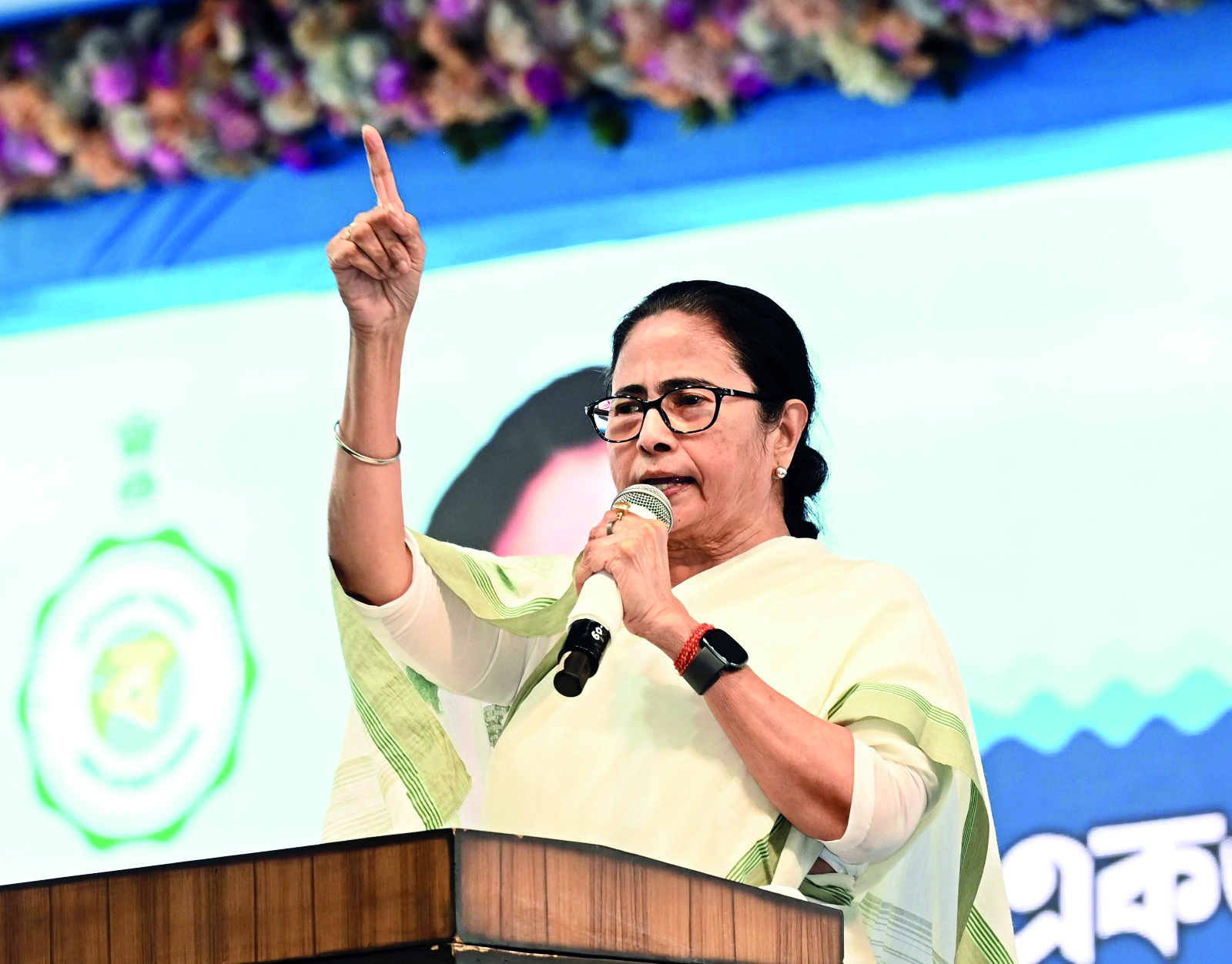
MP, 12 June 2024, Kolkata: Chief Minister Mamata Banerjee advocated zero-tolerance against illegal occupying of government land and directed the administration to take immediate measures for freeing such land.
Banerjee, while chairing her first administrative meeting after the Lok Sabha elections on Tuesday at Nabanna, sought a report from all government departments about respective lands belonging to them and ordered that if any such land is found to be illegally occupied, the police should take action and return it to the respective departments.
All ministers in her Cabinet, department heads and the district magistrates too were virtually present in the meeting.
The majority of the government departments have some quantity of land under them but in a good number of cases, due to lack of surveillance, such lands are being grabbed.
Sources said when a senior official of the Food Processing and Horticulture department (FPI&H) raised the issue of their land for the food processing hub at Bamanghata in Bhangar being illegally encroached upon, Banerjee ordered Kolkata Police Commissioner Vineet Goel to take immediate measures for freeing the land.
The FPI & H department will set up a food processing unit– the first of its kind in the state at the government level at Bamanghata.
Kolkata Metropolitan Development Authority (KMDA) will be executing the project which will have a four-storey building providing space for small food processing units and a market for processed food and vegetables.
It is learnt that the Chief Minister’s office (CMO) in the recent past has received complaints related to illegal occupation of land and in some cases, allegations have surfaced that the character of land has also been altered.
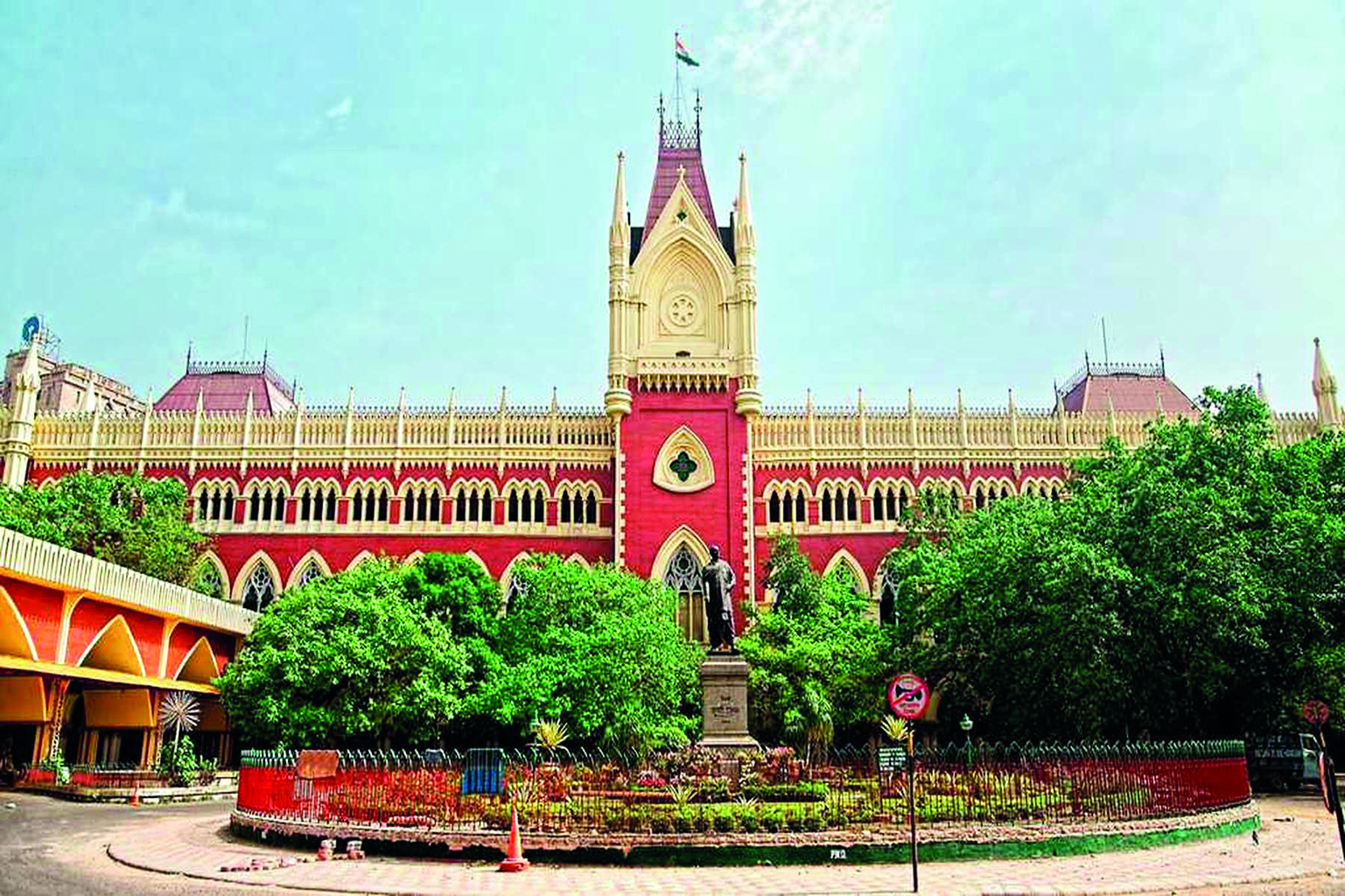
MP, 12 June 2024, Kolkata: Taking into account the allegations of post-poll violence and “apathy” of the state police administration in not tackling the situation, the Calcutta High Court on Wednesday directed that the Central Force deployment in the state should continue till June 21.
Two PILs were filed by the Leader of Opposition Suvendu Adhikari and BJP leader Priyanka Tibrewal regarding safety, security, protection and the prevention of the violence.
In one of the PIL, prayer was made to extend Central Force deployment to ensure peace and safety while the other alleged inaction by state police administration in taking steps in several complaints filed through e-mail.
The Vacation Bench of Justice Kausik Chanda and Justice Apurba Sinha Ray had earlier directed both the state police and Central Forces deployed in the state by the Election Commission of India to take steps to safeguard the lives and property of victims based on complaints filed through e-mail addresses.
The Division Bench of Justice Harish Tandon and Justice Hiranmay Bhattacharyya on Wednesday directed the state to file a comprehensive report on/or before June 14 disclosing the actions and steps taken upon the complaints made through e-mail.
Launched by the British in 1881 and declared a UNESCO World Heritage site in 1999, the Darjeeling Himalayan Railway, popularly called the toy train, is famous for joy rides and draws thousands of tourists
Pramod Giri, THT, 12 June 2024, Siliguri: A 16-year-old boy died under the wheels of a toy train at Kurseong in West Bengal’s Darjeeling district on Wednesday afternoon, officials said, adding that this was the third death of its kind since March 2022.
The deceased was identified as Surya Routh, a resident of Kurseong’s Dak Bungalow area, police said. He was declared dead on arrival at the local sub-divisional hospital.
A police official, who requested anonymity, said, “Surya was standing on the platform when the train, which was going from Darjeeling to New Jalpaiguri, rolled in. The boy somehow fell on the tracks and the train dragged him for some distance although the driver had applied the brakes immediately.”
Launched by the British in 1881 and declared a UNESCO World Heritage site in 1999, the Darjeeling Himalayan Railway, popularly called the toy train, is famous for joy rides and draws thousands of tourists.
“Since the train runs slowly many people tend to ignore the fact that it is a machine and can pose danger as well,” a railway official said on condition of anonymity.
On June 6, a woman named Sita Routh was hit by a train near St Anthony School on the outskirts of Kurseong. She is admitted to a hospital, officials said.
On February 13 last year, a 70-year-old man, Khadga Bahadur Tamang, a resident of Tindharia Tea Estate, died after he was hit by a train.
On March 28, 2022, a man died after he was run over while crossing the tracks at Dagapur on the outskirts of Siliguri.
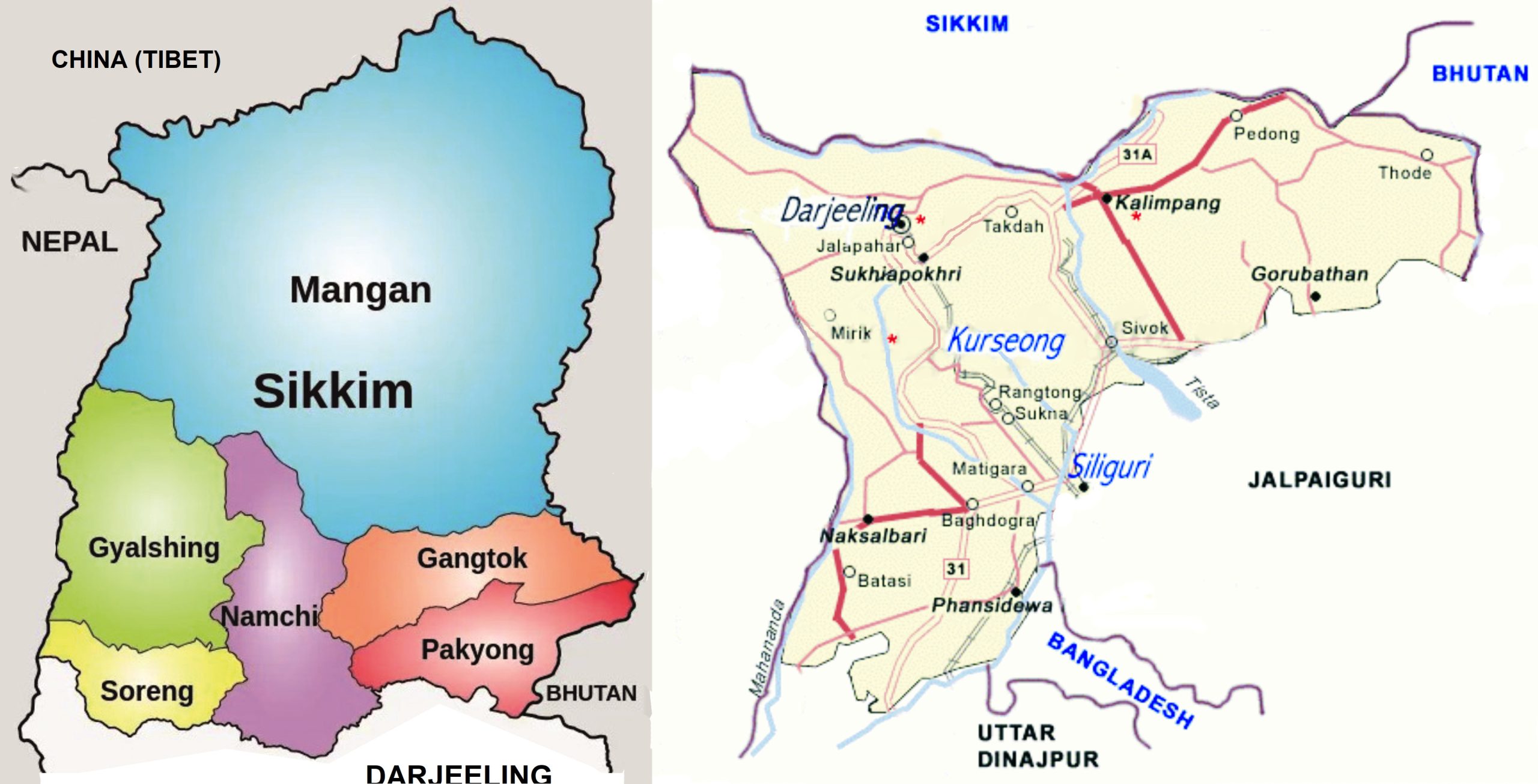
Editorial, EOI, 12 June 2024 : The congratulatory message of Darjeeling M.P. Raju Bista to Chief Minister of Sikkim Prem Singh Tamang on the occasion of the swearing-in ceremony of the latter that people of Darjeeling and Sikkim are blood brothers is highly true.
Historically, the hills of Sikkim Darjeeling had been bound by the same umbilical cord that got separated in 1835 when the British obtained the title over the Darjeeling hills from the Chogyal of Sikkim to set up a health resort.
But there are numerous other ties between the two neighboring hill regions which it is not possible to severe.
One of the most important of them is the infrastructure. When a landslide occurs, for instance, on National Highway 10, Sikkim and Darjeeling suffer equally badly. The landslide near Singtam on Tuesday morning, for instance, had rendered the highway impassable, leading to extensive traffic disruptions and severe inconvenience for commuters.
There was a massive traffic jam, with the queue of vehicles extending to several kilometers. Though the disruption was in Sikkim, the impact was felt in the neighbouring West Bengal district of Kalimpong as well.
Equally, when a landslide on N.H. 10 occurs in some of the vulnerable stretches of the road in the Kalimpong district of West Bengal, commuters from Sikkim going to Siliguri to catch a train, a bus or a flight get equally caught in the disruption.
The disruption caused by the downpour in the Pakyong sub-division, too, affected the traffic flow from Sikkim to the Pedong area of Kalimpong. When the Elevated Highway Corridor from Balason to Sevoke Army Cantonment comes up, it will speed up the flow of traffic to Sikkim as well as the Kalimpong hills of West Bengal.
If the setting up of this road infrastructure attracts investments to north Bengal, both Sikkim and Darjeeling will also enjoy some benefits.
The on-going improvements in this road infrastructure will also increase the tourist flow to the hills of Darjeeling and Sikkim.
When the Buddha Air of Nepal begins its flight operations between Pakyong Airport and Kathmandu and Pakyong, it will help the people of Sikkim and Darjeeling equally. For, many people travel between Nepal and Sikkim and Darjeelng frequently and they have to undergo similar difficulties either by availing the land border between India and Nepal at Kakarvitta or circuitous routes when travelling by air.
For people of Darjeeling and Kalimpong it may be a shorter journey to Pakyong to take a flight than to Bagdogra.
At another level, the demand for recognition of the left-out Gorkha communities as scheduled tribes touches the people of Darjeeling and Sikkim equally; though in the case of Darjeeling it is 11 communities while in the case of Sikkim it is 12. When the Centre agrees to accept this demand, it may have to make it a package deal for Darjeeling and Sikkim.
For, the communities in question are the same and when their demand is accepted in Darjeeling it cannot be ignored in the case of Sikkim.
The two regions had got separated because of historical reasons and it may not be possible to reverse that reality because history, too, has its own momentum. But it is sure the hills of Darjeeling and Sikkim will share their joys and sorrows together
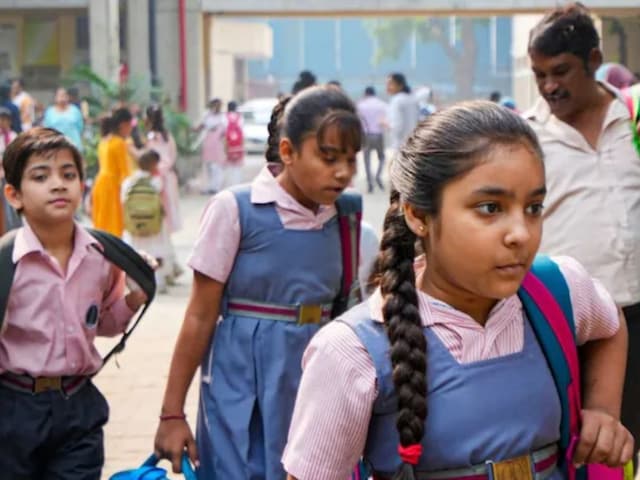
PTI, JUNE 12, 2024 : The West Bengal Board of Secondary Education on Wednesday asked state-run and state-aided educational institutions to tailor school hours due to scorching heat prevailing in most parts of the state.
The West Bengal Board of Secondary Education, referring to a communique from the school education department on June 11, stated in its advisory that upper primary, secondary, and higher secondary schools can collaborate with “stakeholders” to adjust school hours without disrupting the academic calendar and mid-day meal programme.
The advisory emphasised the importance of considering “weather conditions” in their respective areas while making such decisions, WBBSE deputy secretary Rhitabrata Chatterjee said.
Cities and districts of south Bengal, including North 24 Parganas, South 24 Parganas, Howrah, Hooghly, Purnba Medinipur, Paschim Medinipur, Purulia, Bankura, Jhargram, Purba Badhaman, Paschim Bardhaman, Birbhum, Murshidabad, and Nadia, have been experiencing hot and humid weather with temperatures ranging between 35 and 40 degree Celsius.
Although the advisory did not specifically mention any particular zone, a school education department official clarified that the communique aimed to address the difficulties faced by children attending classes in the extreme heat, often leading to illness.
The official further explained that many primary and upper primary schools had already adjusted their class schedules to morning hours.
“Many primary and upper primary schools have already rescheduled classes in the morning hours. We have enabled every institute, even at secondary and higher secondary level, to tweak class hours according to their convenience for the benefit of students and teaching/non-teaching staff till the weather condition improves,” the official added.
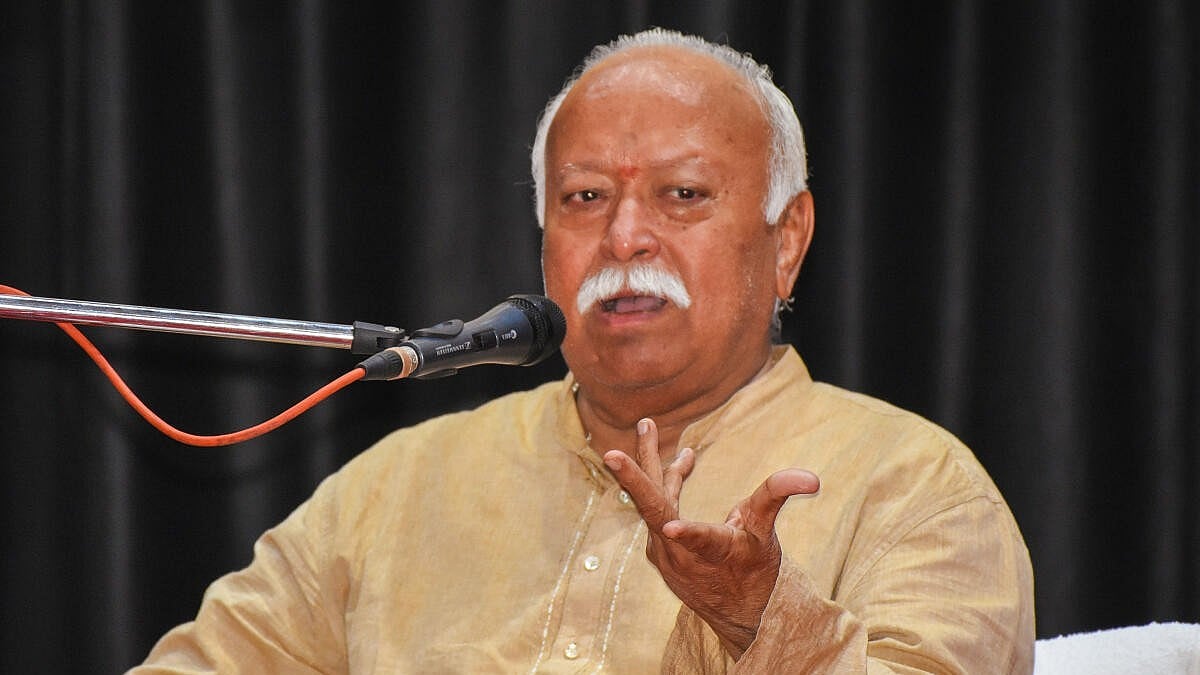
PTI, New Delhi, Jun 12, 2024 : The Congress on Wednesday claimed the Rashtriya Swayamsevak Sangh (RSS) has become “irrelevant” and said the Constitution, democracy and society do not need the Sangh or its chief Mohan Bhagwat as they can protect themselves.
The opposition party’s assertion came after Bhagwat’s remarks on a host of issues, including on the Manipur violence and the just-concluded Lok Sabha polls.
Congress’ media and publicity head Pawan Khera said, “Mohan Bhagwat ji, you reap what you sow. The fault is not of the soil, the fault is of the gardener.”
“When farmers were facing the wrath of the weather and police just outside the capital, you were silent. When a Dalit girl was raped and murdered in Hathras, you were silent. When the rapists of Bilkis Bano were released and your ideological brothers welcomed them, you were silent. When Dalits were being urinated upon, you were silent. When Pehlu Khan and Akhlaq were killed, you were silent. When Kanhaiya Lal’s killers’ links with the BJP were exposed, you were silent,” Khera said of Bhagwat.
“Your silence and Narendra Modi have made you and the Sangh irrelevant. You’ve been made irrelevant by Amit Shah and the BJP. Your last chance was when the BJP leaders were talking about changing the Constitution, you should have spoken out but you remained silent,” the Congress leader said.
“What is the use of speaking now?” Khera added.
The Constitution, democracy and this society does not need the RSS or Bhagwat as they can “protect and reboot” themselves, he asserted.
Congress general secretary Jairam Ramesh also hit out at Bhagwat and posted on X a Hindi couplet by Kabir — “‘Karta raha so kyon kiya, ab kari kyon pachtaye, boye pedh babool ka, amua kahan se paye’ (loosely translating to ‘you shall reap what you shall sow’).”
Bhagwat had on Monday expressed concern over peace eluding Manipur even after one year and said the situation in the strife-torn north eastern state must be considered with priority.
Addressing a gathering of the RSS trainees at the concluding programme of organisation’s ‘Karyakarta Vikas Varg- Dwitiya’ at the Dr Hedgewar Smriti Bhavan premises in Reshimbagh in Nagpur, he said the conflict in various places and in the society is not good.
Bhagwat stressed on unity among all communities in the country, which he said was very diverse though people understand it is one and not separate.
He emphasised the need to get over with election rhetoric and focus on problems facing the nation.
Speaking about the recently held Lok Sabha polls, Bhagwat said the results were out and a government had been formed so unnecessary talk on what and how it happened etc. can be avoided.
The RSS does not get involved in such discussions of “kaise hua, kya hua”, he said, adding that the organisation only does its duty of creating awareness on the need to vote.
Bhagwat stressed on the need for consensus between the ruling side and the opposition so that work for common good (of the masses) can be carried out.
There are always two sides in an election but there should be dignity about not resorting to lies to win, the RSS chief asserted.
Lies were spread using technology (an apparent reference to deepfakes etc.), he added.
PTI, New Delhi, Jun 12, 2024 : Around 40 Indians were killed and over 50 injured in a devastating fire that broke out at dawn in a building housing around 195 migrant workers in southern Kuwait’s Mangaf area, officials said on Wednesday.
The total number of people killed in the Al-Mangaf building is 49 and 42 of them are learnt to be Indians; the remaining ones are Pakistani, Filipino, Egyptian and Nepali nationals, they said.
“In an unfortunate and tragic fire incident earlier today in a Labour housing facility in Mangaf area of Kuwait, around 40 Indians are understood to have died and over 50 injured,” the Ministry of External Affairs said in a statement late on Wednesday night.
Prime Minister Narendra Modi, who described the incident as “saddening”, reviewed the situation at a meeting with External Affairs Minister S Jaishankar, NSA Ajit Doval, Foreign Secretary Vinay Kwatra and Principal Secretary to PM PK Mishra among others.
Following the meeting, the prime minister announced ex-gratia relief of Rs 2 lakh to the families of the deceased Indian nationals from the PM Relief Fund and directed that the government should extend all possible assistance.
External Affairs Minister spoke to his Kuwaiti counterpart Abdullah Ali Al-Yahya on phone and urged him for the early repatriation of the mortal remains of those killed.
“Spoke to Kuwaiti FM Abdullah Ali Al-Yahya on the fire tragedy in Kuwait. Apprised of the efforts made by Kuwaiti authorities in that regard. Was assured that the incident would be fully investigated and that responsibility will be fixed,” Jaishankar said on ‘X’.
“Urged the early repatriation of the mortal remains of those who lost their lives. He emphasized that those injured were getting the requisite medical attention,” he said.
Minister of State for External Affairs Kirti Vardhan Singh is urgently travelling to Kuwait following a direction from PM Modi to oversee assistance to Indians injured in the fire and to ensure early repatriation of mortal remains of those killed.
The officials cited above said most of the Indian victims are from Kerala.
“The fire mishap in Kuwait City is saddening. My thoughts are with all those who have lost their near and dear ones. I pray that the injured recover at the earliest. The Indian Embassy in Kuwait is closely monitoring the situation and working with the authorities there to assist the affected,” Modi said on ‘X’.
In its statement, the MEA said the Indian embassy in the Gulf nation is ascertaining the full details from the Kuwaiti authorities.
“Those injured are presently admitted in five government hospitals (Adan, Jaber, Farwaniya, Mubarak Al Kabeer and Jahra) in Kuwait and receiving proper medical care and attention,” it said.
“According to hospital authorities, most of the admitted patients are stable,” it said.
Following the incident, Ambassador of India in Kuwait Adarsh Swaika immediately visited the incident site and also the hospitals to ascertain the welfare of the Indian nationals.
“The embassy continues to coordinate with local authorities to assist Indian nationals who have been injured in this unfortunate incident and extend all possible support. The embassy is receiving full cooperation from the Kuwaiti authorities,” the MEA said.
“Our Embassy in Kuwait continues to remain in touch with local authorities to provide relief to those affected. The Embassy has established a helpline +965-65505246 (WhatsApp and regular call) for family members to get in touch,” it said.
The fire in Al-Mangaf building was reported to authorities in Al-Ahmadi governorate at 4.30 am and most of the deaths were due to smoke inhalation, Kuwaiti media reported, adding the fire started in a kitchen.
Kuwait’s Interior Ministry in a statement confirmed that the death toll reached 49.
Construction firm NBTC group rented the building for the stay of more than 195 workers, most of them Indians from Kerala, Tamil Nadu and northern states, the Kuwaiti media said.
The NBTC group is partly owned by an Indian, officials said.
Kuwait’s Interior Ministry said criminal evidence department personnel are currently working on identifying the victims and revealing the cause of the fire.
It said strict measures will be taken against building owners who violate laid down norms.
“Unfortunately, we received a report of a fire at… exactly 6:00 am (0300 GMT) in the Mangaf area,” Major General Eid Al-Owaihan, head of the Interior Ministry’s General Department of Criminal Evidence said.
Kuwait’s health ministry said the injured were admitted to several hospitals, with 21 of them sent to Al-Adan Hospital, six to Farwaniya Hospital, one to Al-Amiri and 11 to Mubarak Hospital.
“Amb @AdarshSwaika visited the Al-Adan hospital where over 30 Indian workers injured in today’s fire incident have been admitted. He met a number of patients and assured them of full assistance from the Embassy,” the Indian embassy said on ‘X’.
“Almost all are reported to be stable by hospital authorities,” it said.
The Indian embassy said it is in touch with Kuwaiti law enforcement authorities, fire service and health department for necessary action.
Interior Minister of Kuwait Sheikh Fahad Al-Yousuf Al-Sabah ordered an investigation into the fire incident and issued directions to apprehend the owner and janitor of Al-Mangaf building.
“What happened today is a result of the greed of the company and building owners,” Al-Sabah was quoted as saying by Kuwait Times.
June 12, 2024 : The 2024 national elections braked India’s slide into authoritarianism but did not halt it. The Narendra Modi-led Hindu nationalist Bharatiya Janata Party (BJP) secured 240 of 543 parliamentary seats even as, diminished by voter pushback, the BJP lost 63 seats. Failing to secure the requisite 272-seat majority, Modi forfeited the ability to command a solely BJP national government. Reliant on partners in the seemingly unsteady National Democratic Alliance (NDA), on June 9, Modi assumed office as prime minister of India for a third term.
On June 4, in his victory speech, Modi underscored the religionisation of state and government, rallying: “Bharat Mata ki [Jai]” (Hail to Mother India), a slogan promoted by Hindu nationalists. Bharat Mata, the nation as goddess, objectifies and feminises the state wherein control over women is critical to nationalist assertion. Bharat Mata is associated with Akhand Bharat (undivided India), the delusive once-future homeland of Hindus.
Modi spoke of Odisha and the BJP’s sweep of the 2024 elections, taking 20 of 21 seats. Commending the state’s excellent performance, Modi extolled that, for the first time, the land of the “great god Jagannath” would install a BJP chief minister. A male Odishan tribal figure, Jagannath has been deified, Hinduised, as a manifestation of the deity Krishna.
Modi omitted to note the BJP’s downturn, focusing instead on the exceptionalism of a third consecutive win, stating, “In the third term, the country will write a new chapter of big decisions, and this is Modi’s guarantee,” continuing, “the NDA government will put a lot of emphasis on uprooting all kinds of corruption.” The reference to eradicating corruption was incongruous, given the BJP’s reported recent collusion in the electoral bonds scandal.
The NDA secured a majority in the 2024 Lok Sabha, with support from BJP partners, Telugu Desam (TD), Janata Dal (United), and the ultranationalist Shiv Sena. Modi’s allies include incoming Andhra Pradesh chief minister, Chandrababu Naidu, of TD. Following initial criticism of Modi in 2002 relating to the Gujarat pogrom, Naidu had acquiesced to the BJP leadership. In Delhi, in 2024, the BJP won all seven seats, lost 14 seats in Maharashtra, lost six seats in West Bengal, gained one seat each in Chhattisgarh and Kerala, and secured nine of 14 seats in Assam. Considering the 2019 revocation of Article 370 and India’s continued siege on Kashmir, what does it mean for Kashmiris to have the BJP secure 2 of 5 seats in the 2024 elections?
In Uttar Pradesh, the BJP lost 29 seats. Modi had consecrated the temple in Ayodhya in January on the wreckage of Babri Masjid, a momentous marker for the Hindu Nation. To do so, land was appropriated from local communities, while BJP policies disaffected Muslim, Dalit, and other caste-oppressed groups, impacting electoral decisions against the party.
People attending Ram Temple consecration ceremony in Ayodhya on January 22, 2023. Photo: X (Twitter)/BJP4India.
Speech-Acts
Between 2014 and 2024, Narendra Modi’s words sought to remake India. The speeches attest to Prime Minister Modi’s unrestrained power within his government to reconfigure a gigantic electorate. Modi’s words conjured a world wherein aggrieved Hindus across India may believe in his salvific power to lead India to glory. Modi’s speeches – fervent, narcissistic, significant – became the locus of engagement between him and his “subjects”. Modi’s domineering oratory marshalled crowds, turning his government’s repeated incapacity and misconduct into grievances against those who critique and oppose his positions, his party, and its ideological and political agenda.
Innumerable speech-encounters between Modi and his subjects were formative in delivering India for the Hindu Nation in 2014 and 2019. His rallies were thronged with people, sometimes numbering in the hundreds of thousands. His speeches extended the illusion of intimacy between him and the people while simultaneously reflecting the rising grandeur and drama of his role. Modi spoke to Hindus as a people, a unitary collective. He narrativised political messaging to create fear. The Prime Minister used speech-acts to ostensibly command, convey, scold, accuse, threaten, pledge, endorse, educate, amass, convince, mobilise, and govern. A vortex of emotions and meanings, catalysed to emit strength, induce behaviours, and exhort masses of people.
How have Modi’s obfuscations of state power misled the public? In 2023, the Indian Penal Code (IPC, 1860) was replaced by the Bharatiya Nyaya Sanhita (BNS, Indian Justice Code), effective July 1, 2024. Modi termed it: “A watershed moment in our history…the end of colonial-era laws. A new era begins with laws centred on public service and welfare.” In actuality, the BNS broadens the definition of terrorist actions beyond what the extreme Unlawful Activities (Prevention) Act (UAPA) encompasses, curtails freedoms, targets political opponents and dissent, and criminalises “intentions” and “feelings”.
Modi’s speeches and appearances, carefully crafted, fashion an iconography of allure and invincibility. The deification of Modi, an elected leader, has been self-purposed to induce attachment and ecstatic merger between Modi’s aura and people’s aspirations. Modi presents himself as the spiritual force able to realise people’s yearnings. Modi professes to stand for India’s fulfilment. To those who feel powerless, he bestows the promise of power. To those who feel belittled, he bestows the promise of pride. To those who feel wronged, he bestows the promise of retribution. To oppose Modi, the leader, therefore, is to betray the nation. To unite with the leader promises the achievement of greatness.
The intensity of the speech-encounters between Modi and his Hindu subjects has become the performative mechanism for creating a shared social world for his acolytes that simultaneously serves to exclude “Others”. Stronger than the sum of its making, this habitus has repeatedly inflamed Hindutva adherents to vengeance and redemption. Violence is promoted as a form of personal and national purification.
On May 26, in a televised interview, Modi stated that “Parmatma [god] sent me for a purpose…I have completely dedicated myself to god.” In asserting that his presence on earth as divinely ordained, does Modi see himself as a messiah incarnate? Was Modi seeking to imply that his grip on India’s prime ministership is without end?
Like others before him, Modi relies on repetition to orate the import of an idea and stir an audience. His words codify national enemies, seek to mobilise, and expand Hindutva’s base, and guide “ordinary people” away from the disarray in the political and economic life of the country. In the time of social media, these exhortations reverberate, amplified through platforms such as WhatsApp and X, rendering Modi omnipresent across India.
Fascistic collusions
Modi has been vigorously supported by henchmen, old cronies who helped deliver the Gujarat pogrom of 2002 and newer disciples of the current regime. His calls to action were repeatedly prolonged by Amit Shah, Yogi Adityanath, Yati Narsinghanand Saraswati/Giri, and others. A wave of emergent front runners responded, using virulent speech, even calls to genocidal violence, to gain prominence and contend for power within the party’s hierarchy. Repeatedly, the prime minister failed to call them to order.
Taken together, the Hindutva leadership’s sinister and public vilification of minorities, the political opposition, dissenters, and “seditious” Hindus; comprehensive engineering of social facts; and demagoguery have reified fascistic Hinduism and architectured its manifesto. Most distressing is how this massive and malicious enterprise has found deep resonance among millions and millions of people of dominant descent in India. Irrespective of social conditions, such predilection is not a given and cannot be normalised. It is the dangerous outcome of the collision between authoritarian rulers and majoritarian desires, built upon the fault lines of an inveterate casteist, classist, gender oppressed, and segregated society.
The Hindu Sena, one of Hindutva organisations which filed the intervention application in the case seeking a probe into hate speeches by Muslim leaders. Photo: Facebook/HinduSenuOfficial
Hindu nationalists have used hate speech to provoke grassroots proponents and fence-sitters, using hostile messaging to proliferate political institutions and social media and target opponents, media, and vulnerable communities. The BJP-led government routinely exploited dishonest speech, illiberal governance, and toxic masculinity to militarise the state and massify the Hindu Right’s cadre. Hindu nationalist leaders manipulated the escalating participation of Hindutva-inclined civil society into colossal, riotous actions to exact retribution and discipline voters. Many who did not actively participate, acquiesced through silence.
In Uttar Pradesh, India’s most populous state of over 250 million, 19% of whom are Muslims, the BJP’s 2024 losses also attest to voter concern regarding incumbent head of state, Yogi Adityanath, a Hindu nationalist hardliner. Adityanath has directed various campaigns to override the rights of Muslims and other vulnerable communities. In a video that surfaced in 2014, he reportedly stated that: “If [Muslims] take one Hindu girl, we’ll take 100 Muslim girls. If they kill one Hindu, we’ll kill 100 Muslims.” Adityanath enabled Hindu right-wing activists to make significant inroads within the state machinery. The National Crime Records Bureau data shows that 23,612 riots were reported in UP from 2017-2019.
The Hindu nationalist sweep of Odisha in the 2024 elections is a contrary case in point. Addressing a series of public events in Odisha, in May 2024, Modi, the prime minister of a constitutionally secular republic, started a meeting by invoking Hindu gods: “Jai Jagannath! Jai Sri Ram!” At another, he claimed that the people had developed a “deep emotional connection” with the BJP. At yet another event, Modi spoke of “unprecedented achievements” to be heralded by his government in the next five years.
In Odisha, Hindutva workers were inspired by the BJP’s coalition with the Biju Janata Dal as early as March 2000. Just before, in August 1999, Sheikh Rahman, a male Muslim garment merchant, was tortured in Padiabeda, Mayurbhanj district, his hands severed, burned to death. Approximately 10 percent of the state’s population was conscripted by Hindutva organisations between 2000 and 2008. Dalits and Adivasis were criminalised for their beliefs, practices, and counter-memory, and refusal to be forcibly assimilated into dominant Hinduism. Adivasis across Odisha were forced to chant, “Garbh se kaho hum Hindu hai” [Say with pride that I am a Hindu] at majoritarian rallies. Dalits who elected to convert to Christianity were brutalised to “return” to Hinduism. Massified violence against Christians of Dalit and Adivasi descent erupted in 2007 and 2008, in continuum with the ferocious targeting of Muslims in the state. The absence of accountability to these events bolstered the BJP’s electoral incursion in Odisha.
Weaponising acrimony
In weaponising majoritarian subjects as agents of hate, the imaginary of India as a Hindu State is fait accompli. In propagating its mandate, between 2014 and 2024, the BJP government sought to amalgamate prejudice with discrimination. State policy and practice focused on the intersections of racism and cultural nationalism. In doing so, Hindu nationalists erected a “deeper state” establishing crime zones and regulated anarchy to fortify structural racism and criminality, and forge robust proximities between Hindu Right cadres and militias, government, and law enforcement.
India’s Muslim communities and cultures are foremost among those fallaciously presented as causal to India’s historical, present, and future malfunctions. Islamomisia and racialisation of Muslims serves to homogenise Hindus as a “race”. Hatred (of Muslims) has been justified based on concocted behaviours (i.e., hypermasculinity) and falsified evidence (i.e., “love jihad”). Fascistic Hinduism, portrayed as patriotic nationalism, became the war to save and fabricate the Hindu Nation, carried out via malevolent operations that polarised and religionised the body politic, like “bulldozer justice,” anti-conversion campaigns, and the prejudicial citizenship experiment privileging Hindus.
Representative image of a bulldozer demolishing a settlement. Photo: By arrangement/File
In Dumka on December 15, 2019, Modi asserted that the anti-Citizenship (Amendment) Act, 2019 (CAA), protests: “were a “conspiracy against the country,” calling protesters “conspiracy makers.” On December 18, 2019, BJP leader Kapil Mishra stated, “Desh ke gaddaron ko, goli maaro saalon ko [Shoot the traitors of the nation, shoot the */derogatory].” On December 22, another BJP leader, Anupam Pandey, reiterated on Facebook Live: “Desh ke gaddaron ko, goli maaro saalon ko.”
Between December 12 and 23, 2019, police fired on civil society dissenters across India who were protesting the ratification of the CAA on December 12, 2019, resulting in the deaths of 25 persons, a majority of whom were Muslim males. On December 24, Mishra recorded a public message, stating, “Will your eyes open up when the fire has reached your homes?” On December 25, Yati Narsinghanand Saraswati used slurs against Muslims, labelling them “jihadis” and “pigs.” He described anti-CAA protesters as “enemies,” calling for them to be incarcerated, and should they still not conform, for them to “be sentenced to death.”
In Rajasthan, where the BJP lost 10 seats in the 2024 national elections, Modi had stated in April 2024, that a Congress win would lead to the redistribution of people’s wealth [possessions] among “those who have more children” and to “infiltrators,” reportedly referring to Muslims. In May 2024, in Uttar Pradesh, Modi alleged that the “Congress and the [winning] Samajwadi Party tried to spread lies in the name of CAA. They tried to push Uttar Pradesh and the entire country towards riots.”
The right-wing is still in power
The 2024 elections were not a decisive victory for India’s right-wing and the right-wing is still in power. Upper caste urbanite Hindus reportedly voted for the BJP in large numbers. Dissenting votes were driven by minority and marginalised communities, Muslims, Dalits, Sikhs, Adivasis, and their allies. Among and beyond them, millions of wage labourers, farmers, and economically shattered communities–devastated by the government’s policies, discourses, and practices—voted to oust the BJP.
Following his investiture on June 9, Modi proposed to “move forward with new energy and new courage.” Can Modi, who has been politically narcissistic, stabilise a coalition government and keep in power those that have abetted him since Gujarat, such as Home Minister Amit Shah? Among the nerve centre of the Hindu Right, the RSS, and its affiliate organisations, many are disgruntled with Modi, and may seek to assert control. This may engineer a crisis within the ranks of the BJP, and lead to the incurable disempowerment of Narendra Modi and a party governed by his ideals. However, this will not halt the march of Hindu nationalism in India. Rather, it may prompt the Hindu Right to rely upon its grassroots infrastructure to optimise previously deployed and new strategies of mass violence and aggressive social disruption.
The electoral gains by the I.N.D.I.A. alliance reflect immense voter discontent with the BJP’s blatantly despotic policies, securitization, dog whistling that provoked social violence, information insecurity, economic implosions, and democratic backsliding. The political terrain is ideologically discordant. Can the I.N.D.I.A. alliance amend its own frailties, to halt the rightward trend and recuperate India’s democracy?
The majoritarian deluge into the country’s bloodstream has induced disorder and caused extensive damage across the education sector, law and order, judiciary, and development, and will require forceful political and social reform. The decade-long divisive and violent transformation of society heralded by the Modi-led BJP and the Hindu Right has led the onslaught on India’s already conflicted democracy and engineered severe estrangements and alienation between neighbours, communities, and peoples who rely on each other in everyday life. Targeted communities and nonbelievers are ruptured from the impact, which like slow-release poison, has galvanised a savagery that has spread to terrify and destroy life-worlds.
In modern history, authoritarian regimes have been unable to retain their stranglehold on power. But they have often not gone quietly. The longer the Modi regime endures, the more likely will be its desperation to grasp at domination and the more hazardous its actions. For the Modi-led BJP government surely fears that, once dislodged, accountability is to come.
Sources said the incident took place at Uttar Simlabari village that is adjacent to Chilapata forest and under Alipurduar–I block
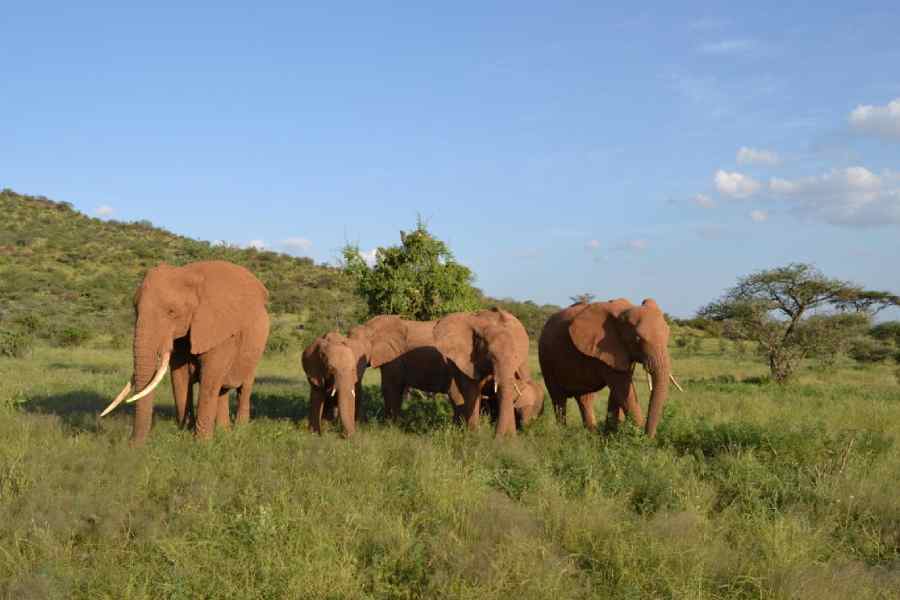
TT Bureau Jalpaiguri, Alipurduar, 12.06.24 : A wild elephant trampled to death the owner of a private lodge in Alipurduar early on Tuesday morning.
Sources said the incident took place at Uttar Simlabari village that is adjacent to Chilapata forest and under Alipurduar–I block.
Around 4am, a lone tusker came out of Chilapata forest and damaged a hut at Deodanga of Simlabari. The animal then entered a paddy field adjacent to a private lodge.
According to sources, 30-year-old Kingshuk Karjee, who owns the lodge, came out with four others and tried to drive the animal away.
“The elephant, however, retaliated and gave them a chase. Others managed to escape but it grabbed Kingshuk with its trunk and then trampled him to death. Later, it then went back to the forest,” said a source.
The locals then informed the foresters and a team reached the spot.
“It is an unfortunate incident. Kingshuk died while trying to drive away the elephant from the agricultural field. The department will provide the stipulated compensation (of ₹5 lakh) to the bereaved family,” said Sudipta Ghosh, the range officer of Chilapata forest range.
In another incident, a wild elephant came out of the Gorumara National Park early on Tuesday morning and damaged six houses in Uttar Dhupjhora area under Matiali block of Jalpaiguri.
Sources said the elephant strayed into the village in search of food around 2am. Also, it was raining heavily then.
It then damaged the houses and later, walked into the Panjhora forest.
The affected families have demanded compensation from the forest department.
Leopard attack
Subal Roy, a 51-year-old farmer got injured in a leopard attack in Falakata block of Alipurduar on Tuesday.
He is under treatment at Birpara state general hospital.
Sources said Roy, who stays in Chandnikura village, was working in the field. Around 6am, he spotted a leopard lying on the ground.
As he retreated, the leopard attacked him and mauled his back. Roy raised an alert and locals rushed him to the hospital.
Foresters were informed and a team reached the spot. They have laid a cage in the areas to trap the animal, sources said.
Pangolin rescued
A pangolin was rescued from Demka Jhora, a locality in Malbazar block of Jalpaiguri on Tuesday afternoon.
Locals said over the past few days, poultry were going missing in the village.
On Tuesday, some of them spotted the animal near a pond. They caught it and informed the foresters.
Later, the pangolin was handed over to foresters of Malbazar wildlife squad.
The GTA had submitted a proposal to the state government for the construction of three roads to ease traffic congestion in the hills, said GTA chief executive Anit Thapa
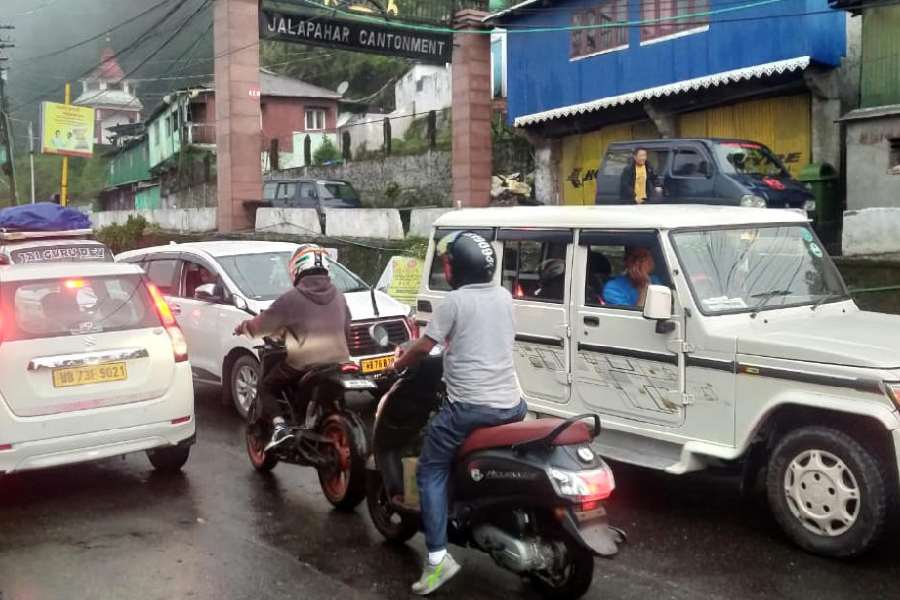
A traffic snarl on NH55 at Jorebunglow, 8km from Darjeeling: The Telegraph
Vivek Chhetri, TT, Darjeeling, 12.06.24 :The Bengal government has in principle agreed to the Gorkhaland Territorial Administration (GTA)’s proposal to construct alternative roads from Darjeeling to Teesta Bazar and from Bungkulung to Kurseong.
The two alternative roads are proposed largely to ease traffic congestion while travelling to Darjeeling.
“The GTA had submitted a proposal to the state government for the construction of three roads to ease traffic congestion in the hills. Of the three roads, the government has agreed in principle to construct two roads,” GTA chief executive Anit Thapa told The Telegraph.
The 35km-long alternative route from Darjeeling town will start at Lebong and end at Teesta Bazar. Lebong is at the opposite end of Jorebunglow where vehicles coming from Gangtok, Kalimpong, Siliguri and Mirik converge creating huge traffic snarls on a stretch of 8km.
During peak tourism season, it takes hours to cover the 8km stretch and the entire traffic in Darjeeling town also gets affected.
“This alternative route from Lebong would ensure that vehicles to Kalimpong and Gangtok can exit Darjeeling from the other end of town. In fact, from Teesta Bazar, one can also go to the Dooars and Siliguri,” said a GTA source.
The in-principle nod to the new road was granted on May 24, said the source.
The other road agreed on by the government is from Bungkulung to Kurseong. “This road will be 14km long and will ease travel from Mirik to Kurseong,” said a source.
Sources said the new road would touch the Pankhabari road at Ambootia Phatak, just a few kilometres below Kurseong town.
The third proposal made by the GTA was to construct a road from Bungkulung in the Mirik subdivision to Sukhiapokhri touching Nagri and Dhajea but it was not approved by the government immediately.
Sources said on June 3, the GTA also wrote to the secretary of the public works department (PWD) to take over the construction of a circular road from Lebong to 3rd Mile via Pandam tea garden.
The GTA has taken up the construction of the 13km stretch from Lebong to 3rd Mile via Pandam and Rangaroon tea gardens. “The GTA has requested the government to take up the balance work,” said a GTA source.
This route would also provide an alternative route to people travelling to Kalimpong, Gangtok, Takdah, Lopchu and Peshok among other places.
SANDIP C. JAIN, EOI, 12 June 2024 : The beautiful hills, forests, ravines and rivers of North Bengal have developed into a happy hunting ground for tourists from across the globe. Tourism has rapidly changed the economy and way of life of this area in drastic ways.
Politically too, this area has for the past decade, become a happy hunting ground for the BJP which now considers this region as its own backyard.
Having won seven of the eight Lok Sabha seats in the region in 2019 and six of the eight this time, north Bengal is a BJP fortress though the dream of the party of conquering the rest of West Bengal has received a setback.
With a total of 12 seats in its tally from the state in the Lok Sabha poll from a total of 42, it has been a disappointing performance for the BJP in the rest of the 34 seats in south Bengal.
The Darjeeling seat is one which the BJP has been dominating for the last three general elections and this time round was no exception.
From Jaswant Singh to S S Ahluwalia to Raju Bista, the Darjeeling seat seems to have become a safe seat for the BJP over the years. Raju Bista, the sitting MP, has won the Darjeeling seat for a second time; though with a much reduced margin.
There of course was no doubt that Bista would win again once his name was declared. Riding on the back of several developmental projects that he has brought into Siliguri, like the Balasan-Sevoke highway and the Bagdogra International Airport project, it was definite that the Siliguri voters would once again prefer Bista over Gopal Lama, the Trinamool Congress candidate.
Bista of course did not have too much to show to the population of the Darjeeling hills by way of any development projects but then the hills anyway vote on sentiments, not development. Even on the subject of sentiments, there was a growing dissent against the BJP in the hills for the hill voters felt that they had been taken for a ride more times than they could digest. Despite exploiting the emotive issue of a separate state and tribal status for the remaining 11 communities, the BJP has nothing to show on this account. This was in some ways responsible for its reduced vote share in the hills.
Bista polled 679,331 votes this time which was about 70,000 votes less than in the last elections. This figure shows that the BJP lost almost 9 percent of the votes to what it polled in 2019. In 2109 BJP polled 59.2 percent of the total votes cast whereas this year the percentage of the total votes it received was about 51.
Trinamool candidate, Gopal Lama on the contrary polled 500,806 votes which was a big rise from the 336,624 votes that the Trinamool candidate polled in the 2019 elections.
With approximately 164,000 more votes this time, the Trinamool can take some solace in this year’s performance, despite losing the electoral battle.
If this increase in Trinamool votes is analyzed, it clearly shows that it has gained both in the hills and in the plains.
It has gained approximately 102,000 votes in the four assembly segments in the plains, Siliguri, Matigara, Phansidewa and Chopra; while in the three hill assembly segments of Kalimpong, Darjeeling and Kurseong it has gained about 62,000 votes. On a percentage basis, in 2024, Trinamool gained almost 60 percent votes in the hills over what it received in 2019. In 2019 it received a meager 103,500 votes in the hills while this time round they polled 165,494 votes.
Percentage wise, the Trinamool received just 26.56 per cent votes in the Darjeeling seat in 2019 while getting 38.5 percent votes this time, recording a substantial increase of over 12 percent.
An analysis of the BJP vote share in the hills shows that in 2019, the saffron party polled 344,100 votes from the hills while managing to get 258,978 votes this time. This shows a significant drop of over 85,000 votes. This means that the BJP has lost almost 25 percent votes this time in the hills in comparison to the last elections.
The BJP leadership in the hills must take note of this big drop in vote share and try to analyze the cause of this vote loss.
Of course the Anit Thapa led Bharatiya Gorkha Prajatantrik Morcha which is in alliance with the Trinamool is now a stronger force in the hills than what it used to be earlier; with it stranglehold over the Gorkhaland Territorial Administration and the panchayat bodies in the hills but the loss of BJP votes has more to do with just this.
The fact that the overall image of the BJP across the country has taken a beating on bread and butter issues of the public also has contributed to the BJP vote loss in the hills.
With the BJP now no longer in absolute control of things at the Central level, having to share power with conservative politicians like Chandra Babu Naidu and Nitish Kumar, the dream of the hills of a separate state or even scheduled tribe status for the 11 communities seems unlikely to be fulfilled in the near future.
There is no way that the BJP will rock the already fragile boat that it will have to sail for the coming few years.
Another aspect that needs to be discussed is the better than expected performance of the Congress candidate this time. Polling 83,374 votes, Munish Tamang the Congress candidate supported by the CPI (M) did himself proud especially for the fact that he was brought into the election fray at the very last moment with almost no time to prepare.
Many in the hills had considered him to be the best of all the candidates in the election lineup. But the Congress has practically no grass-root infrastructure in the area.
Hence he had always been just a marginal player in these elections. There is little doubt though that someone of his calibre, representing the hills in Parliament would have been a big plus for the entire Darjeeling region.
The BJP will have to do some serious thinking if it wants to remain relevant in the hills in coming years. It has to realize is that the 258,978 votes it received in the hills this time were not just BJP votes but boosted by voters of the Gorkha National Liberation Front, the Gorkha Janmukti Morcha, the Communist Party of Revolutionary Marxists and a host of smaller parties.
(The writer of this article is the Editor of Himalayan Times,Kalimpong)
SUJAL PRADHAN, EOI, GANGTOK, JUNE 11, 2024 : A team from Buddha Air visited Pakyong Airport on Tuesday to conduct a feasibility study for launching flight operations between Kathmandu and Pakyong.
The visit included a presentation by the Air Traffic Controller and an airport tour led by Airport Director S.K. Singh.
The three-member team from Buddha Air included Uday Krishna Shrestha, Om Pradhananga, and Jiwan Basnett. Buddha Air plans to operate two daily flights: one from Kathmandu to Pakyong and another from Kathmandu to Pakyong via Guwahati.
The flight from Kathmandu to Pakyong will take about one hour, while the flight from Pakyong to Guwahati will take around 35minutes.
As per reports, the proposed fare for Kathmandu to Pakyong is expected to be between Rs. 6,000 and Rs. 7,000, but Singh has requested Buddha Air to reduce it to Rs. 5,000 to Rs 6,000.
The airline is confident there will be enough passengers on these routes. Buddha Air is already operating flights from Kathmandu to Varanasi and is seeking permission for a new route from Janakpur to Ayodhya.
The tentative timing for the new flights is between noon and1.30 pm. The flights will use ATR 500aircraft which can accommodate 85 to 90 passenger
Heavy rain, mudslide, cause devastation in Pakyong village
EOI, PAKYONG, JUNE 11, 2024 : The heavy rainfall on the night of June 10 in Thek village, Parakha Block, in Pakyong, has brought about devastating consequences, causing extensive damage to properties and endangering public safety.
The relentless downpour in the locality has triggered erosion along the river bank, compromising the structural integrity of many, rendering them unfit for human occupation. Two houses were completely destroyed and about 10 others wer
e badly damaged. Responding to the urgent need for assistance, two relief camps have been established to provide shelter and aid to the affected residents.
The Latuk Primary School and the house of Bishnu Maya Rai and Roshan Rai have been designated as shelters for the displaced people. The loss of livestock during the calamity has also been significant,
The destructive force of the floodwaters swept away three bridges along the Maltini River, snapping the only connection to Thek Village and isolating its inhabitants from essential services and support networks.
The land adjacent to the Maltini River has borne the brunt of severe erosion at multiple sites, causing significant alterations to the natural course of the river and posing further risks to the surrounding area.
A joint inspection was carried out on Tuesday under the directive of DC Pakyong to assess the extent of the damage and coordinate relief efforts. MLA Gnathang Machong Pamin Lepcha, members of the Zilla Panchayat and Panchay at Latuk Thek, SDM Pakyong and other senior officials were present.
Pamin Lepcha asked for the formation of an assessment group to examine the terrain uphill along the Maltini River from the National Highway and Infrastructure Development Corporation of India Road construction site. She also asked for the quick restoration of the water and electricity supplies, as well as the accessibility of the roads.
PTI, Kolkata, Jun 11, 2024 : Senior TMC leader Saket Gokhale on Tuesday claimed that three BJP MPs from West Bengal are in touch with the party and the saffron party’s tally in Parliament would soon come down to 237.
The comments drew sharp reactions from the West Bengal BJP unit, which dubbed the claim as “baseless” and asserted that the state unit stands united.
The Trinamool Congress secured 29 out of 42 Lok Sabha seats in West Bengal.
The BJP, in contrast, faced a significant setback, dropping to 12 seats from the 18 it won in 2019.
“As of today, the numbers in the Lok Sabha are BJP: 240 INDIA: 237. Three BJP MPs in West Bengal are in touch with us and there will be a nice surprise soon. After that, BJP: 237 INDIA: 240.
“Modi’s creaky coalition is a temporary structure which isn’t going to last very long,” Gokhale, a Rajya Sabha MP, posted on X.
In the just-concluded Lok Sabha polls, the BJP with 240 seats fell short of a majority but the NDA secured the mandate with 293 seats. The Congress bagged 99 seats while the INDIA bloc got 234 seats. Following the polls, two Independents who won have also pledged support to the Congress, taking the INDIA bloc tally to 236.
Reacting to Gokhale’s claim, BJP state spokesperson Samik Bhattacharya said the TMC is “daydreaming”.
“Since 2014, the TMC has been daydreaming of becoming the pivotal force in the union government but its hopes were dashed not once but thrice. The BJP and NDA stand united. No BJP MP from Bengal is in touch with the TMC,” he said.
SNS, 11 June 2024 : The state government will include boys and girls belonging to the general category, minorities and OBC in its Yogyashree scheme that provides free coaching to students sitting for engineering and medical courses.
The scheme was so long applicable to the SC and ST categories.
In 2024, those who had received training in Yogyashree scheme, got 23 ranks, including 13 IIT seats in JEE Advanced, 75 ranks in JEE (Main),. Seventy five students had cracked JEE (Main) and 432 cracked WBJEE and 110 ranks in NEET.
The state government has increased the number of centres to 50 and 2000 aspirants will receive the coaching. The coaching will be given from students studying in Class XI onwards.
Chief minister Mamata Banerjee in her X handle wrote: “We are proud that our Yogyashree scheme which we started to provide free-of-cost training to SC/ST students of the state for admission in engineering and medical courses has been yielding increasingly greater and greater benefits for our SC/ST boys and girls. Now, we shall include the boys and girls of minority, OBC and general categories also in this scheme.”
She said this would benefit the students coming from economically-challenged backgrounds immensely.
She emphasised this scheme would bring out engineers and doctors in large numbers from the weaker section of the society.
“Let our boys and girls from the weaker sections be engineers and doctors in larger numbers. We shall now include students of Minority, OBC, and General categories in this scheme. Kudos to them!,” she further posted.
The state’s budget also revealed an enhancement in financial assistance under the Lakshmir Bhandar Scheme. General category households will now receive Rs 1,000, while SC/ST households are set to receive Rs 1,200.
Additionally, SC/ST women will been titled to Rs 1,200, and others will receive Rs 1,000 under the Lakshmir Bhandar Scheme, effective from April 2024.
The West Bengal government on Tuesday said its ‘Yogyashree’ scheme for students will now include beneficiaries from the minority, OBC and general categories. The scheme was launched in January to provide free-of-cost training to SC and ST students of the state for engineering and medical courses.
“In consideration of the value of this critical training support to our disadvantaged boys and girls, we have increased the number of centres in the state now to 50, and number of our supported trainees to 2,000, and the training will be given from Class XI onwards for better preparation,” the Chief Minister said.
“Let our boys and girls from the weaker sections be engineers and doctors in larger numbers,” she added.
Bengal’s Chief Secy said that the government of West Bengal increased the Dearness Allowance and Dearness Relief by 4 percent in the state. The government notification was released on Tuesday
ANI, 11 June 2024 : The government of West Bengal increased the Dearness Allowance and Dearness Relief by 4 percent in the state. The government notification was released on Tuesday.
The order comes into effect from April 1, 2024.
In a letter dated June 11, Additional Chief Secretary to the Government of West Bengal Dr Manoj Pant said that Governor CV Ananda Bose was pleased to enhance of the rate of Dearness Allowance and Dearness Relief.
Dr Manoj Pant said, “The Governor has been pleased to decide that enhancement of rate of Dearness Allowance and Dearness Relief in respect of the employees and Pensioners / Family Pensioners respectively of the State Government and Government aided Educational Institutions, Statutory Bodies, Government Undertakings, Panchayats including Panchayat Karmee, Municipal Corporations / Municipalities, Local Bodies etc. and Daily Rate of Wages for the daily rated workers as was allowed vide in Finance Department Memorandum No.1090-F(P2) dated March 1, 2024 shall be effective from April 1 instead of May 1.
IANS, Kolkata, June 11, 2024 : West Bengal was the fourth highest recipient state in the latest instalment of tax devolution released in the last phase as per the figures released by the Union Finance Ministry on Tuesday.Of the total Rs 1,39,750 crore of the latest instalment released, West Bengal has got a share of Rs 10,513.46 crore, which is fourth highest after Uttar Pradesh Rs 25,069.88 crore, Bihar at 14.056.12 crore and Madhya Pradesh at Rs 10,970.44 crore.
As per the statement by the Union Finance Ministry, with the latest release, a total of Rs 2,79,500 crore had been devolved to the different states till June 10 for the current financial year of 2024-25.
Economic analysts believe that the fresh figures released for West Bengal immediately after the BJP-led NDA came to power at the Centre for the third consecutive term are expected to silence the ruling Trinamool Congress for some time about their constant allegations against the Union government of not releasing Central funds for the state under various heads, including tax devolution instalments.
In fact, in almost all the pre-election campaign rallies Chief Minister Mamata Banerjee had said that despite collecting crores of rupees as tax from West Bengal, the Union government had been reluctant in releasing its due shares to the state government.
However, economic analysts point out that the state-wise release of tax devolution instalments in the last phase shows that the amount going to the kitty of West Bengal is much higher than the BJP-ruled states like Assam, Gujarat and Rajasthan among others.
In fact, at a meeting with the newly elected party MPs on June 8, CM Mamata Banerjee outlined the roadmap for Trinamool Congress on the floor of the 18th Lok Sabha, where she made it clear that one of the three key issues to be highlighted by the party in the coming days within the two Houses of Parliament will be non-release of Central funds to the state government under various heads.
PIB release state- It has been decided that apart from the regular release of the devolution amount for the month of June 2024, one additional instalment will be released. This release cumulatively amounts to Rs. 1,39,750 crore in the current month. This will enable State Governments to accelerate development and capital spending.
The Interim Budget 2024-25 has a provision of Rs. 12,19,783 crore towards devolution of taxes to States.
With this release, the total amount devolved (for FY 2024-25) to States till 10 June 2024 is Rs. 2,79,500 crore.