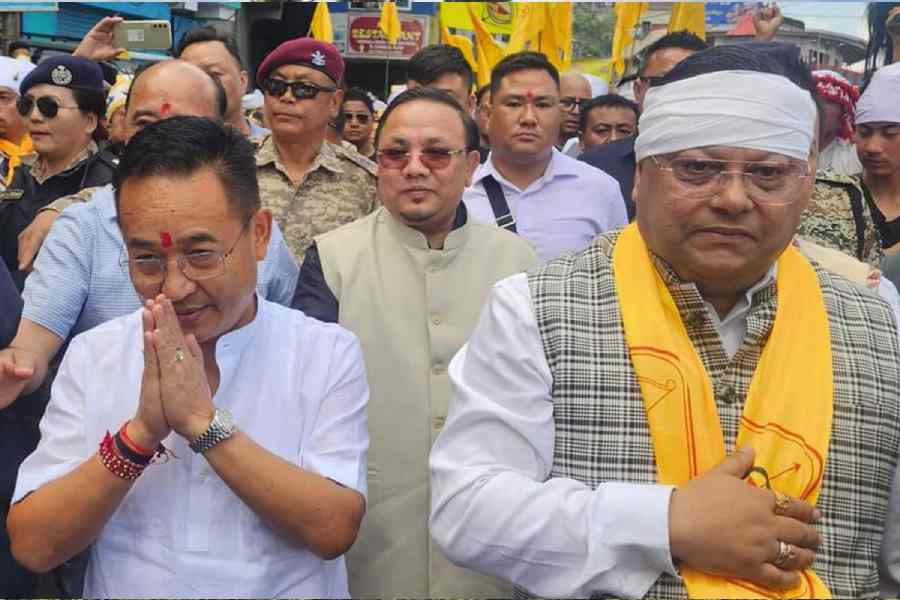
One is from Nadia and seven are from various places in North 24-Parganas, none is from Matua community
Snehamoy Chakraborty, TT, Calcutta, 31.05.24: The Union home ministry on Wednesday evening emailed citizenship certificates to at least eight persons from Bengal ahead of the last phase of elections, which includes constituencies like Barasat, Dum Dum, Jadavpur and Basirhat with significant refugee population.
“The process of granting citizenship certificates under the Citizenship (Amendment) Rules, 2024, has now commenced in the State of West Bengal, where the first set of applications from the state were granted citizenship by the Empowered Committee, West Bengal,” a press release issued by the ministry reads.
None of the eight is from the Matua community.
Of the eight persons with certificates, one is from Nadia and seven are from various places in North 24-Parganas.
Alhough the election in Nadia is over, nine constituencies, including three of North 24 Parganas — Dum Dum, Barasat, and Basirhat, will go to the polls on June 1. After the CAA rules were notified, the first set of citizenship certificates was handed over to 14 persons in New Delhi on May 15.
Giving citizenship certificates to the first set of eight people from Bengal since the notification of the Citizenship Amendment Rules, 2024, assumes significance as chief minister Mamata Banerjee has claimed that those staying in the country with voting rights are already citizens of India.
A section of people from the Matua community is also in a dilemma over applying for citizenship status as it is mandatory to submit documents proving their connection with Bangladesh. As a large number of them do not have any document to prove their Bangladeshi roots, most Matuas are yet to apply for citizenship, a source said.
A BJP leader, however, said these citizenship certificates would help convince refugees to apply for the status.
“Chief minister Mamata Banerjee said she would not allow CAA to be implemented in Bengal. Today, eight Bengalis received their citizenship certificates…. Those who received their citizenship status will not face any problem staying in the country. This is called Modi’s guarantee, and no power can stop CAA. All refugees will get their citizenship status,” BJP leader Jagannath Chattopadhyay wrote on his social media handle.
Bikash Mondal, 34, now living with his elderly parents, wife, and three-year-old son in Nadia’s Bhimpur, is one among those who received citizenship status on Wednesday evening. He applied for it after the notification of the rules in March this year.
He came from Jhenaidah in Bangladesh in December 2012, claiming that as a Hindu he was forced to leave his country because of religious persecution.
“I am very happy to receive citizenship of this country. I was interviewed by the Empowered Committee. I am relieved,” said Bikash, who claimed he would apply for a similar status for his parents, who came to India in 2012.
Asked if he gave any document to prove his Bangladesh roots, Bikash said: “Yes. I submitted my birth certificate provided in Jhenaidah.”
Sceptics are unconvinced.
“It is a clear bluff…. The certificates show they were provided under the CAA of 2009. The BJP has been trying to reap political dividends ahead of the last phase of polls by providing citizenship certificates to only a few people. If those people were granted the status following the new law, why did they not mention it on the certificates?” asked Prasenjit Bose, an economist and activist who is a face of the movement against the citizenship matrix.
Trinamool said citizenship certificates should be unconditional. “How can those people who had to flee from Bangladesh show papers to prove their Bangladesh ties?” asked a TMC leader.
MP, 31 May 2024, Kolkata: The Election Commission of India (ECI) has informed state Chief Electoral Officer (CEO) Aariz Aftab that teachers from government-aided or sponsored schools cannot be appointed as counting agents for any candidate.
This rule also applies to individuals receiving any honorarium from the government or those working part-time in state-aided institutions. Six phases of elections have already been held and the last (7th) phase of polls is scheduled on Saturday (June 1) in nine Parliamentary Constituencies in Bengal — Kolkata South, Kolkata North, Dum Dum, Jadavpur, Diamond Harbour, Basirhat, Barasat, Mathurapur and Jaynagar.
The counting is scheduled for Also Read – ‘No one can stop change of power in Delhi on June 4’ June 4. As per the rules of the Commission, no state government employees can be deputed as counting agents.
However, in earlier elections there were allegations of engaging teachers in such duties. The poll watchdog this time has clarified well in advance to ensure that teachers of the government-aided or sponsored school are not appointed as counting agents for any candidate.
As per rules, during the counting of elections under the supervision and directions of returning officers, the counting is held in the presence of the candidates. But as counting is held at different venues a candidate can’t remain present at all venues.
Against this backdrop, the candidate deputes one counting agent on his or her behalf for overseeing the counting process on behalf of the concerned candidate. If any government employee is involved in the counting process, questions of bias may crop up, hence the EC does not allow any such agent during the counting of votes.
SUJAL PRADHAN, EOI, GANGTOK, MAY 30, 2024 : In a Facebook post on Thursday, Sikkim Chief Minister Prem Singh Tamang highlighted the recent success of the assembly and 18th Lok Sabha elections in the state, calling them the most peaceful in the history of Sikkim. The Chief Minister also shared details of an important meeting he chaired with Sikkim Krantikari Morcha (SKM) party candidates at his official residence.
Addressing the meeting, the Chief Minister highlighted the imperative of maintaining harmony and asked all SKM members to maintain peace. “It is our utmost duty to remain in a harmonious state, guide all members of our organization properly, and maintain peace, goodwill, friendship, and brotherhood,” he stated.
Reflecting on the recently concluded elections, Tamang praised the unparalleled peace and organization. “This 18th Lok Sabha and 11th Sikkim Legislative Assembly election have been the most peaceful in Sikkim’s history,” he stated. He extended thanks to various officials and departments for their contributions to the electoral process. Referring to the high voter turnout, the Chief Minister said a total of 462,456 voters participated; a turnout of 83.5percent which was two percent higher than in 2019. “This remarkable turnout sets a new record for the state, surpassing figures from other states across the country. The people of Sikkim are the true recipients of heartfelt thanks and congratulations,” he said.
The Chief Minister commended the participation of 146 Assembly candidates and 14 Lok Sabha candidates and appreciated the role of every individual in ensuring a peaceful election. He reiterated the government’s commitment to maintaining peace and security in the state.
“Our mission will continue in the coming days to ensure complete peace and security in the state for the benefit of the Sikkimese people,” he assured. The Chief Minister called for unity among the diverse communities of Sikkim. “Though we belong to different castes and communities, we are all children of the same mother, Sikkim. Mutual respect, love, and harmony among us are our foremost duties,” he said. The meeting commenced with a two- minute silence to pay tribute to the late Sonam Gyatso Bhutia, a former legislator and vice-president of the SKM central executive committee, who had passed away recently.
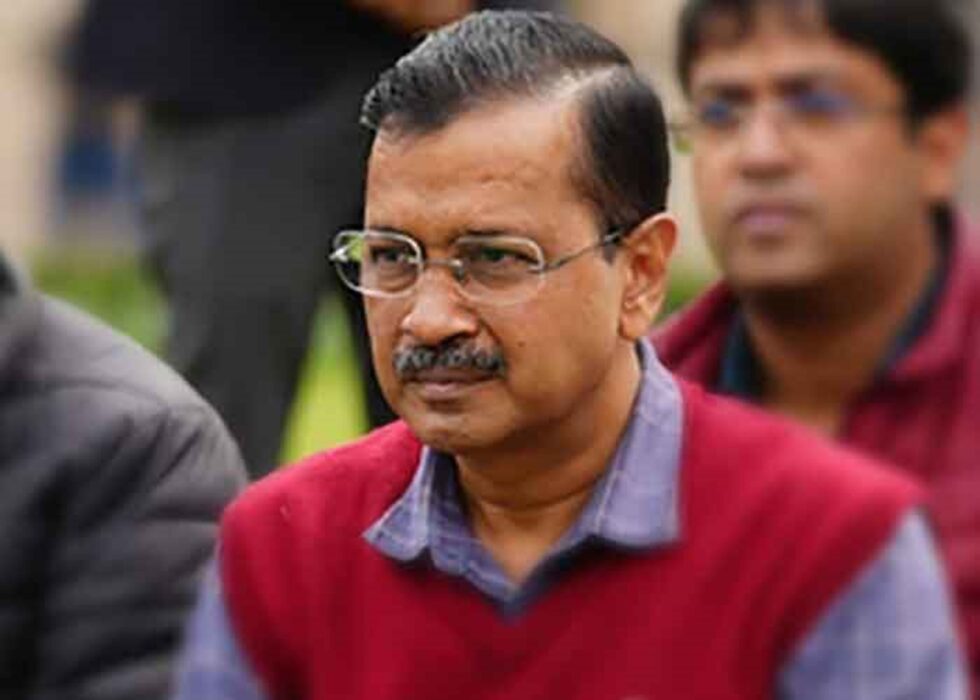
PTI, New Delhi, May 30, 2024 : A Delhi court on Thursday issued notice to the ED on Chief Minister Arvind Kejriwal’s plea seeking regular bail in a money laundering case related to the alleged excise scam.
Special Judge Kaveri Baweja, who initially directed the central probe agency to file its response to Kejriwal’s plea by Saturday, later fixed the matter for June 7 after the Enforcement Directorate (ED) sought more time to respond.
The judge, however, directed the ED to file its response by Saturday on Kejriwal’s another plea seeking interim bail for a week on medical grounds.
Kejriwal is currently out on interim bail, granted by the Supreme Court, in the case till June 1.
The Supreme Court registry on Wednesday refused urgent listing of Kejriwal’s plea seeking extension of his interim bail by seven days for undergoing certain medical tests, saying since he was given liberty to move the trial court for regular bail, the plea was not maintainable.
The AAP leader had sought extension of his interim bail by seven days to undergo a host of medical tests, including a PET-CT scan, in view of “sudden and unexplained weight loss coupled with high ketone levels”, which are indicative of kidney, serious cardiac ailments and even cancer.
The chief minister, in his fresh plea filed before the apex court on May 26, said he wanted to surrender before the Tihar jail authorities on June 9 instead of June 2, the scheduled date for his return to prison.
The top court had on May 10 granted 21-day interim bail to the chief minister to enable him to campaign during the Lok Sabha polls.
It had directed him to surrender on June 2, a day after the last phase of the seven-phase poll gets over.
The matter relates to the alleged corruption and money laundering in the formulation and execution of the Delhi government’s now-scrapped excise policy for 2021-22.
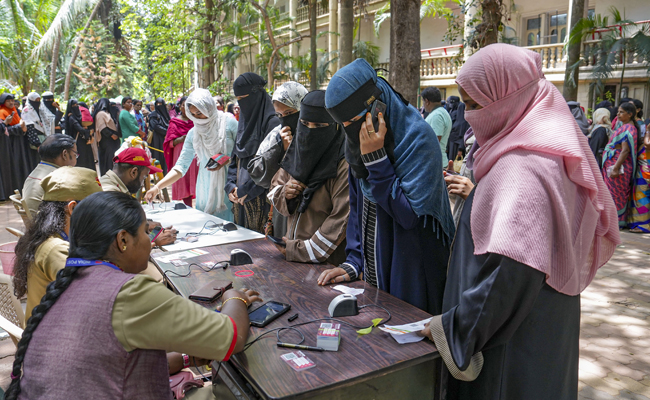
PTI, 29 May 2024, Bengaluru : An otherwise silent General Post Office in Bengaluru is witnessing an unprecedented rush of women hurrying to open India Post Payment Bank accounts, anticipating a monthly deposit of Rs 8,500 into their accounts if the INDIA bloc comes to power at the Centre.
The elections are still in the process but women, largely from the minority communities sporting burqas, stood in long queues to open the account.
Some of them believed that opening the IPPB account would ensure that they get Rs 8,500 per month.
A woman said she stood in the queue early in the morning itself. Another said everyone in her neighbourhood was saying that money would start coming from the day the account is opened, so she too came to open an account.
Most of the women the news agency spoke to were from Shivajinagar, Chamarajpet and surrounding places in the city. Talking to reporters, Chief Post Master of GPO Bengaluru H M Manjesh said people have been coming to the office to open IPPB accounts in the belief that the Department of Post would credit Rs 2,000 or Rs 8,500 into their accounts.
“Actually it is a rumour. Somebody has spread this rumour. The department will not pay any amount to them. However, this account can be used for any type of online transaction or even Direct Benefit (Transfer) scheme,” Manjesh clarified. He said that the department has already informed the customers about this.
“We have displayed some posters also. In spite of that, customers are requesting that we open IPPB accounts for them.” There was such a rush that more counters were opened outside the GPO building, under the open sky, he added.
“Earlier we used to open 50 to 60accounts in a counter. Now we have made separate arrangements. We have brought our postmen for this purpose and regularly we are opening around 500 to 600 accounts, sometimes even 1,000 accounts in a day,”Manjesh said.
According to sources in the department, this rush has been witnessed for the past three days. It is learnt that some Congress MLAs spread the rumours, believing which the women made a beeline for the GPO. The MLAs said that the women will start getting money after June 4 “when the INDIA bloc will come to power”.
The Congress has made a promise to launch the Mahalakshmi scheme under which Rs 8,500 will be directly credited into the account of women heads of families belonging to Below Poverty Line (BPL) category. It is similar to the Gruha Lakshmi guarantee scheme started by the Karnataka government in which Rs 2,000 is paid to women heads of BPL families.
PTI, Kolkata, May 29, 2024 : West Bengal Chief Minister Mamata Banerjee on Wednesday accused Prime Minister Narendra Modi and the BJP of “spreading lies” about funds being provided to the state and challenged the PM to prove his claim.
Addressing a rally at Metiabruz in Diamond Harbour constituency, the Chief Minister said she was “ready to sacrifice her life” but wouldn’t allow divisive politics of the saffron camp such as the CAA, NRC and UCC in the state.
“Prime Minister while addressing rallies in Bengal is saying the Centre has sent funds for the state which the TMC has siphoned off. He is saying the Centre had sent funds but those were looted by us. The PM is lying. I challenge him to prove that the Centre has released funds for the state. This is a blatant lie,” she said.
Reacting to Banerjee’s remark, BJP state spokesperson Samik Bhattacharya said, “The Prime Minister has only tried to highlight the corruption during the TMC regime. It is a well-known fact that the TMC is neck-deep in corruption. The remarks by the Chief Minister reflect that she is rattled after being exposed.” Claiming that the BJP will pay for their arrogance in the polls, Banerjee said the PM’s recent remarks that the BJP’s best results will come from Bengal is “actually an admission that the party will face a rout in other parts of the country.” “So does that mean that the BJP will lose elections in Uttar Pradesh, Maharashtra and Bihar? It seems the saffron party has conceded defeat even before the polls are over,” she said.
The CM alleged that the BJP has been spreading canards through misleading advertisements.
“As part of Modi Babu’s guarantee, they were publishing misleading advertisements in newspapers against us. We lodged multiple complaints but there was no action. Yesterday, the High Court also stated it is illegal. They don’t release MGNREGA funds but spend crores on conspiracies, to buy votes and spread propaganda,” she said.
Expressing skepticism about the BJP’s ambitious target of achieving 400 seats in the Lok Sabha elections, she said people will reject them.
“The entire country has understood that the BJP is a party full of thieves. It is the TMC which will show the way after the elections,” Banerjee said.
The TMC had walked out of the INDIA bloc in West Bengal in January but asserted that she would continue to be part of the opposition bloc at the national level.
Vowing not to allow the implementation of CAA and NRC in the state, she said, “If people do not want divisive CAA, NRC or UCC that will erase our diversity, they must vote against the BJP.”
Congress general secretary Jairam Ramesh also asked if the prime minister prioritised his PR over vaccines and funds under the National Health Mission
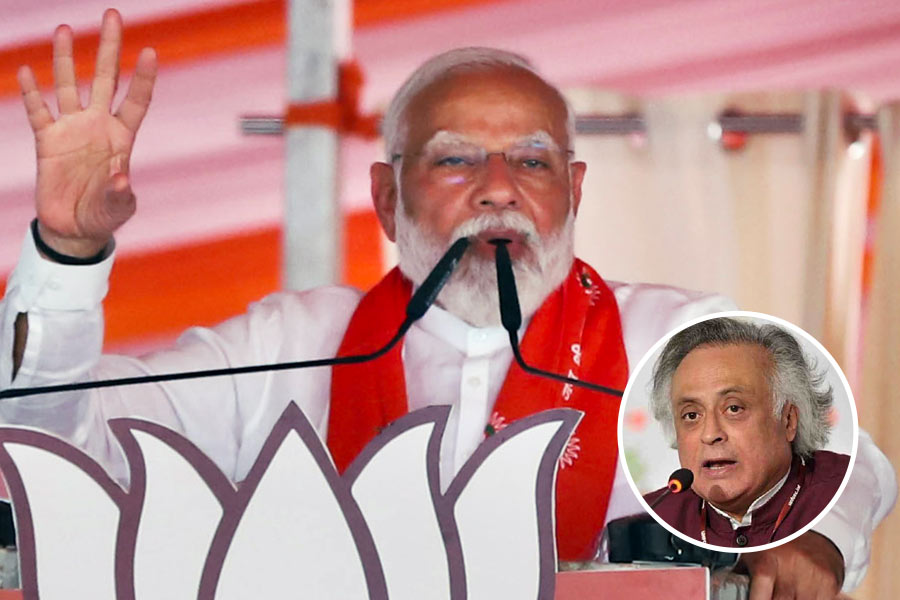
Narendra Modi and Jairam Ramesh (inset): File
PTI, New Delhi, 29.05.24 : The Congress on Wednesday asked Prime Minister Narendra Modi whether he was withholding Rs 7,000 crore of paddy procurement funds to West Bengal and if the CBI case against Suvendu Adhikari has got “washed away” in the BJP’s washing machine.
Congress general secretary Jairam Ramesh also asked if the prime minister prioritised his PR over vaccines and funds under the National Health Mission.
“Today’s questions for the outgoing PM’s West Bengal visit: Is the outgoing PM withholding Rs 7,000 crore of ration funds so that his face is plastered on ration shops? Did Suvendu Adhikari’s CBI case get washed away in BJP’s washing machine? Does the PM prioritise his PR over vaccines for India’s children?” he asked in a post on X.
He posed the questions on a day the prime minister is campaigning in West Bengal for the last phase of elections on June 1.
“In an incredibly petty move, the Centre has been withholding National Food Security Act funds from West Bengal for not displaying the outgoing PM’s face on ration shops. In an attempt to coerce the state government into displaying sign boards and flexes featuring the outgoing PM’s photos, the Centre has withheld Rs 7,000 crore of paddy procurement funds,” Ramesh charged.
He said this could seriously hinder the state’s paddy procurement and the availability of rice for the public distribution system.
“Why has the outgoing PM so callously neglected the health and wellbeing of the people of West Bengal? Is his publicity more important than people’s daily food?” the Congress leader asked.
He said in April 2017, the CBI filed an FIR against then TMC MP Adhikari in connection with the Narada scam.
In April 2019, the CBI sought sanction from the Lok Sabha speaker to prosecute him and in December 2020, Adhikari joined the BJP, and the CBI never received the Lok Sabha speaker’s sanction.
Similarly, he said, TMC leader Tapas Roy was raided by the ED in January this year in connection with a money laundering case and by March, he had also joined the BJP. Just a few months prior to his joining, Adhikari had alleged that Roy was involved in a municipal recruitment scam but this allegation also “disappeared” once Roy joined the party, he alleged.
“The PM’s ‘Bhrashtachar Hatao’ slogan is shamelessly plastered all over the country even as his party is busy handing tickets to corrupt politicians.
“Can the outgoing PM shed any light on why CBI and ED action against these leaders has been stalled? How can the BJP make pretensions to eradicating corruption when their ‘washing machine’ is clearly at full spin in West Bengal?” Ramesh asked in his post.
He also alleged that the government has blocked the National Health Mission funding to over 11,000 sub-health centres in West Bengal. These sub-health centres form the first line of defence for India’s poor – they are staffed by nurses and provide vaccines for children, tablets, and medicines for common fever, malaria, TB, and other infectious diseases, he claimed.
While the sub-centres are supposed to be called Ayushman Bharat Health and Wellness Centres, the state government had named them Sushasthya Centres, he claimed, adding that in a letter on November 25 last year, the Union Ministry of Health and Family Welfare (MoHFW) wrote to states, ordering them to rename sub-centres “Ayushman Arogya Mandir” and paint them orange.
The medical community has criticised this attempt by the BJP to “saffronise” medical centres, and the state government has refused to implement it, he said.
“In a petty and vindictive move, the Modi Sarkar seems to have blocked funds just because the state government refused to paint sub-centres a different colour. This comes after the Centre has already blocked state funds to MGNREGA and a Central housing scheme.
“In their vindictiveness, why is the BJP denying essential health services to the poorest communities in the state? Does the outgoing PM prioritise his PR over vaccines for India’s children?” Ramesh asked.
Amitava Banerjee, MP, 28 May 2024, Darjeeling: Ajoy Edwards, Gorkhaland Territorial Administration (GTA) Sabhasad and president Hamro Party, in a letter to Chief Minister Mamata expressed concerns over the fate of areas affected in the October 4, 2023, Teesta flash floods in Kalimpong district with the monsoons fast approaching.
He further urged the Chief Minister for the rehabilitation of the affected families displaced in the flash floods.
“As you are aware, due to the flash flood in the Teesta basin during the intervening night of October 3 and 4, 2023, National Highway 10, other connecting roads, villages, bazaars, bridges, buildings and the Teesta hydropower station have been submerged and washed away.
This has severely affected communication with international borders and the strategic position of Sikkim, as well as the Kalimpong and Darjeeling districts (GTA region). It has been found that 335 houses, including 223 houses in Rangpo, 10 houses in Tarkhola, 3 houses in Mamkhola, 45 houses in Bhalukhola and Malli, 39 houses in Testa Bazar and Teesta Bridge, 9 houses in Galle Khola, 4 houses in Rayang and 2 houses in Bangay have been partly or fully damaged.
At this moment, affected people are residing at various relief camps,” stated the letter. In his letter, Edwards wrote: “With the monsoon season approaching, the hill people are deeply concerned about the fate of the displaced families and individuals who are currently staying in various relief camps.”
He further mentioned that with heavy siltation owing to the flash flood and with the quality of work on riverbank protection, highway (road) protection and other related works concerning the Teesta River may not have been maintained, the National Highway 10, would not be able to bear the brunt of the upcoming monsoon.
“In such an event, the vehicles from Sikkim and also Kalimpong run via Ghoom and Darjeeling. Already our roads are overburdened and are facing serpentine traffic jams.
The Government of West Bengal and Sikkim should coordinate to work out and streamline the traffic flow in case of such eventuality so that traffic can flow smoothly” stated Edwards, talking to the Millennium Post.
“Furthermore, initiatives for relief distribution and rehabilitation aimed at supporting displaced families and individuals affected by the Teesta River disaster should be completed without any delay,” urged the letter.
Edwards has also written to the Chief Minister of Sikkim; Union Ministry of Road Transport and Highways; Principal Secretary, GTA and the District Magistrates of Kalimpong and Darjeeling and to the Northeast Frontier Railways.
EOI, Editorial, 29 May 2024 : The call for collective effort between Sikkim and Darjeeling to secure tribal status for communities made by Chief Minister of Sikkim Prem Singh Tamang at a cultural event of the Kirat Khambu Rai community is pregnant with significance; all the more so because the Chief Minister has issued the call in the presence of Gorkhaland Territorial Ad-ministration Chief Executive Officer Anit Thapa, a senior leader from the hills of Darjeeling.
The immediate reason for the call of the Chief Minister is surely the clear signal from the outgoing BJP government at the Centre that after the formation of the new government the demand for tribal status for communities would be taken up after the elections.
With the BJP ahead in the race for the formation of the next government, there is the expectation in the hills that the long-standing demand would now be taken up. Here, Sikkim and the hill areas of Darjeeling and Kalimpong have almost the same demand.
While the demand in the hills of Darjeeling and Kalimpong is that 11 left-out Gorkha communities be included in the Scheduled Tribe list, in Sikkim the same demand has been made for 12 com-munities.
Eleven of the 12 communities are also the same; so there is a strong ground that Sikkim and Darjeeling should move in tandem with this demand and it is reasonable to expect that the demands of Sikkim and Darjeeling would be fulfilled simultaneously.
It is true that Sikkim and Darjeeling have justified their demands on different grounds but that may not make a significant difference.
Darjeeling wants scheduled tribe status for 11 left-out communities as the permanent solution for the political issues of the hills. If all the different strands of the larger Gorkha community are recognized as scheduled tribe, it would be easy to bring the autonomous hill council under the purview of the Sixth Schedule of the Constitution; with more administrative and financial powers. Sikkim, on the other hand, has justified the demand on the ground that during the rule of the Chogyal all these communities used to be treated as tribes.
In Sikkim, of course, Delhi will have to take cognizance of the extra protections accorded to the Bhutia and Lepcha communities under Revenue Or-der no. 1; a legacy of British rule but protected under Article 371A of the Constitution.
From the historical point of view, it will be justified if the Centre treats the people of Sikkim and those of the Darjeeling hills at par while examining the issue of tribal status for communities. For, people belonging to the same communities inhabit the two adjoining hills of Darjeeling and Sikkim.
Darjeeling was once a part of Sikkim; to be separated and included in British territory in 1835. Now 75 years after Independence there is ground for justification if the wheel turns.
It is a different question, however, if the wheel will turn full circle as the solution for the political problems for these hills. In Darjeeling, there are political parties and groups which support this idea.
The view is different in Sikkim where the ethnic Sikkimese people enjoy several protections under the Sikkim Subject Certificate and the Certificate of Identification. If Sikkim and the hills of Darjeeling and Kalimpong are brought under the same political umbrella, these rights may get diluted.
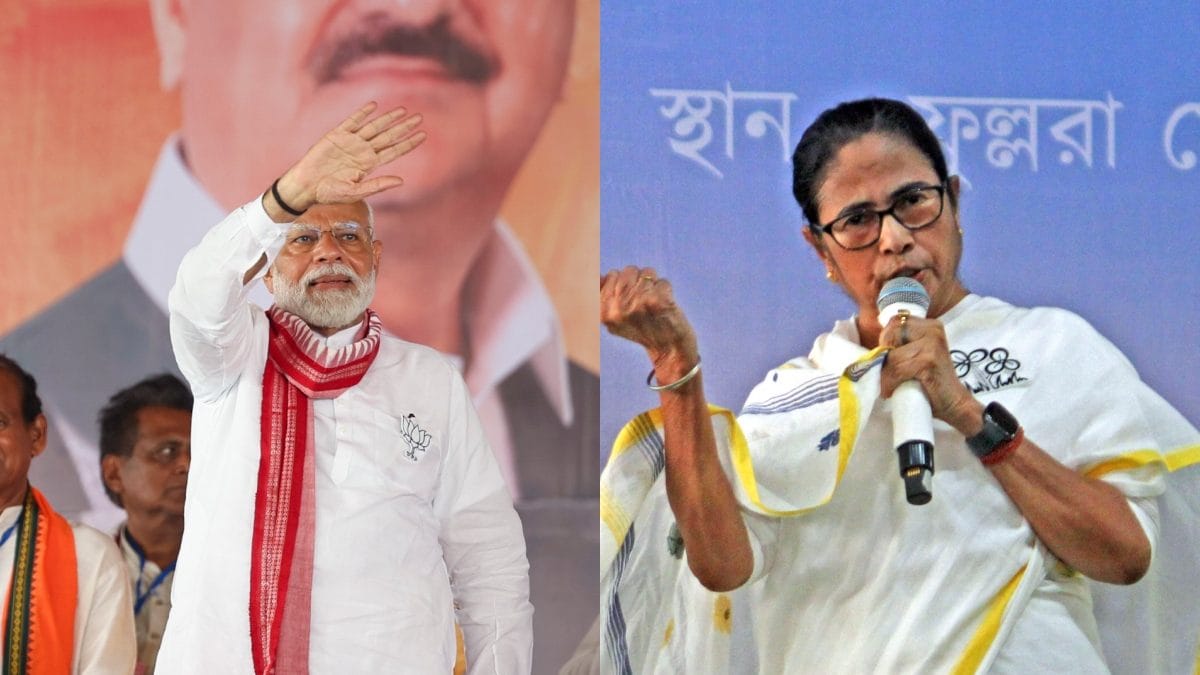
PTI, Kolkata, May 28, 2024 : Prime Minister Narendra Modi and Chief Minister Mamata Banerjee led roadshows in different part of Kolkata and its surrounding on Tuesday to garner support for their respective party candidates as the Lok Sabha elections approaches its final phase.
Prime Minister Modi led a vibrant roadshow from Shyambazar Five Point Crossing here on Tuesday.
The roadshow was in support of BJP candidate Tapas Roy, who switched to the saffron camp just months ahead of the elections. Before the event, Modi visited Maa Sarada’s residence at Bagbazar and paid homage to her. He also paid tribute to Netaji Subhas Chandra Bose at his statue at Shyambazar Five Point Crossing.
Accompanying him were prominent West Bengal BJP leaders, including Sukanta Majumdar and Suvendu Adhikari.
The roadshow started around 7:10 pm. Modi stood atop a decorated vehicle, resplendent in saffron hues and adorned with flowers, images of the PM and BJP’s election symbol, the lotus.
As the convoy made its way through the bustling streets, the Prime Minister waved at the crowd, which gathered on both sides of the street. Women supporters, dressed in saffron saris, also participated in the colourful procession.
Chants of ‘Jai Shri Ram’ and ‘Phir Ek Baar Modi Sarkar’ reverberated in the air as the vehicle passed by, with many onlookers capturing the event on their mobile phones. On the other hand, Chief Minister Mamata Banerjee held two road shows in support of Trinamool Congress candidates in Dum Dum and Kolkata, walking nearly nine kilometres in a day.
In the first road show, the TMC supremo walked from Birati Banik More to Airport gate number two on Jessore Road, a distance of nearly four kilometres, along with party leaders and workers.
The roadshow in Dum Dum Lok Sabha constituency was held in support of the TMC’s veteran leader and candidate Saugata Roy, who is seeking a fourth consecutive term from the seat.
Apart from Roy, TMC ministers Sujit Bose and Chandrima Bhattacharya accompanied Banerjee in the Dum Dum roadshow, while in south Kolkata, city mayor and minister Firhad Hakim walked along with her. In the second road show, Mamata walked nearly five kilometres from Entally Market to Ballygunge Phari in south Kolkata, treading a total of nearly nine kilometres in a single day.
This rally was in support of TMC’s Kolkata Dakshin candidate Mala Roy, who is seeking a second term from the constituency, and Kolkata Uttar candidate Sudip Bandyopadhyay, fighting for a straight third term from the seat.
The fate of all these BJP and TMC candidates will be decided on June 1, the closing day of the Lok Sabha elections.
Narendra Modi being handed a Trishul by Adityanath. Photo: X/@narendramodi
Prabhat Patnaik, Jacobin.com and The Wire,
27 May 2024 : As India’s leader, Narendra Modi has deepened the neoliberal framework in place since the early 1990s. The social crisis arising from that model drives Modi’s government to rely more and more on a dangerous, authoritarian discourse of social division.
The decade during which Narendra Modi has been the prime minister of India has witnessed a sharp increase in income and wealth inequality. According to the World Inequality Database, the share of the top 1 percent in national income, at 22.7 percent in 2023, is higher than at any time over the last century.
This increase in inequality has been accompanied by a rise in the ratio of the population facing absolute nutritional deprivation. India’s quinquennial surveys on consumer expenditure show a significant rise between 2011–12 and 2017–18 in the percentage of the population unable to access a minimum daily calorie norm per capita, which is 2,100 for urban and 2,200 for rural areas.
India is believed to be one of the fastest growing economies in the world, although growth rate figures are known to be highly exaggerated. However, it currently ranks 111 out of the 125 countries in the Global Hunger Index — a rank that has worsened over the last decade.
Neoliberal Continuity
Liberal opinion tends to put the entire blame for this extraordinary increase in inequality on the Modi government. It is certainly true that the government has pursued policies that palpably favor monopoly capitalists — especially some relatively new business houses that constitute Modi’s “cronies” — while unleashing a crisis for petty production, above all small-scale agriculture.
However, these policies are not the government’s own innovations. It has only carried forward the established neoliberal agenda faithfully and blindly. Blaming the Modi government alone, therefore, wrongly exonerates neoliberalism from the charge of impoverishing the working people.
In fact, the trends toward increasing levels of inequality and nutritional deprivation have been evident ever since the introduction of neoliberal policies in 1991. The share of the top 1 percent in national income, for instance, is estimated to have risen from 6 percent in 1982 to over 21 percent in 2014. Nutritional deprivation had increased quite substantially between the 1993–94 and the 2011–12 Consumer Expenditure Surveys.
Some measures are considered to be the specific follies of the Modi government, such as the sudden demonetization of nearly 87 percent (in terms of value) of the country’s currency notes in 2016 in the name of fighting “black money,” or the introduction of a Goods and Services Tax in 2017, in lieu of the earlier sales tax, which was supposed to facilitate “unifying the national market.”
Yet while the government has implemented these measures mindlessly, they are generally drawn from the tool kit of the international financial institutions. Moreover, Modi’s government has had the support of those institutions for such moves.
Neoliberal Crisis
The Modi government can be faulted for adhering doggedly to the neoliberal agenda even at a time when neoliberalism had run into a crisis and was generating massive unemployment. Nowhere was this more evident than in its enactment of three farm laws that would have eliminated the regime of support prices provided by the government for food grains.
Support for cash crops had been removed earlier, exposing farmers to wide fluctuations in world market prices, and thereby increasing their debt burden, which in turn has resulted in mass suicides among them. A remarkable year-long struggle by farmers forced Modi to backtrack on these laws, which if implemented would have destroyed the country’s self-sufficiency in food grain production (admittedly at low levels of consumption) and exposed it to even greater food insecurity.
An increase in economic inequality, both within countries and for the world as a whole, is an immanent tendency under neoliberalism. This is because the mobility across countries of capital-in-production that neoliberalism entails exposes real wages in all countries, including those in the Global North, to the downward drag exercised by the vast labor reserves of the Global South.
These reserves do not dwindle, despite the relocation of activities from the Global North to the Global South, because the introduction of freer trade among countries — another feature of neoliberalism — intensifies competition among them. It also accelerates technological-cum-structural change that increases the rate of growth for labor productivity in each country.
This in turn keeps down the rate of employment growth, often even to a level below the natural rate of growth of the labor force, thereby even increasing the relative size of the labor reserves. Thus, the level of real wages is suppressed under neoliberalism while labor productivity increases rapidly everywhere, raising the share of surplus in total output within countries and also globally.
The crisis of neoliberalism is directly linked to this growth in inequality. Since working people consume a much larger share of their incomes than those to whom the surplus accrues, the rise in the surplus share creates a tendency toward overproduction. This has revealed itself internationally after the collapse of the housing bubble in the United States.
Slowdown
In India, the effects of this collapse were temporarily kept in abeyance through an aggressive fiscal policy that violated the limitations on the fiscal deficit-to-GDP ratio. With the reimposition of this limit, which came roughly around the time that the Modi government took over, the slowing down has affected India as well.
The clearest manifestation of the crisis in India today is the extremely high rate of unemployment. Unemployment, as we noted earlier, was growing under neoliberalism even before the crisis, because the rate of employment growth was below the natural rate of growth of the labor force. In the Indian case, one must also mention the distressed farmers flocking to cities in search of jobs. With the onset of the crisis, we see the further addition of unemployment due to inadequate demand.
Unemployment is the single most acute problem facing India today. Because of large-scale casualization of the workforce, it takes the form of a reduction in the hours of employment for most people, rather than a complete lack of work for some. As a result, it is difficult to capture through conventional measures.
However, the results of surveys asking people about their own employment status show a significant jump in the unemployment rate during the post-pandemic years. There has also been a significant increase in the demand for jobs under the government-run rural relief program, known as the Mahatma Gandhi National Rural Employment Guarantee Scheme, which also confirms the phenomenon of rising unemployment.
Unemployment is particularly severe among young people — 44 percent in the twenty to twenty-four age group, according to an International Labour Organization report — and in rural India. Real wages of rural workers have remained at best stagnant since 2014–15, and perhaps even declined (depending on the deflator used). In the case of construction workers, a numerically large segment of the labor force, wages certainly have declined, which further confirms the phenomenon of growing unemployment.
Indeed, the two phenomena — greater unemployment and stagnant or reduced real wages — together explain the increase in absolute nutritional deprivation mentioned earlier. This increase is only partially alleviated, but not negated, by the government’s scheme to provide five kilos of free food grains per month to about eight hundred million beneficiaries. This scheme has been continued from the pandemic years, against the professed convictions of those in power.
Corporate-Hindutva Alliance
The Modi government’s wholehearted embrace of neoliberalism, even when the crisis of that economic model is causing mass distress, is precisely what constitutes its attraction for Indian monopoly capital.
Earlier support for neoliberalism in the belief that it would bring about rapid growth that would ultimately benefit everyone disappears when there is mass unemployment and acute distress. That is when neoliberalism requires a new prop to sustain itself, for which it forms an alliance with neofascist elements.
In India, this neoliberal/neofascist alliance has taken the specific form of a corporate-Hindutva alliance. The Modi government is an expression of this alliance.
Its purpose is to bring about a change in discourse so that issues of unemployment, inflation, and economic distress are pushed to the background. Meanwhile, Hindu supremacism comes to the forefront, even as the government continues to pursue an aggressive neoliberal strategy to the benefit of globalized capital and the domestic monopoly capital integrated with it.
Neofascism displays all the features of classical fascism: state repression subverting democratic institutions and abrogating democratic rights; an attack on the hard-won rights of workers and peasants; the combination of state repression with street violence by fascist thugs; and the “othering” of a hapless minority group and the fomenting of hatred toward it.
We can also observe a close nexus with monopoly capital — especially with a new stratum of monopoly capital constituted by the cronies of the government — as well as the apotheosis of a supreme leader and an immense centralization of powers and resources. This enables the carrying forward of an agenda of social counterrevolution, which in India means reversing the progress made toward overcoming caste and gender oppression.
In the current international context, one must add to this list of features adherence to neoliberalism and the accommodation of globalized capital, of which domestic monopoly capital constitutes an integral part.
Discourse of Division
However, in contrast with classical fascism, neofascism cannot overcome the problems of economic crisis and mass unemployment. This is because increased state expenditure for raising aggregate demand can work only if it is financed either by a fiscal deficit or by taxing the rich.
State expenditure financed by taxing working people, who consume most of their incomes anyway, does not add to aggregate demand. In today’s context, globalized finance frowns upon the idea of a larger fiscal deficit or higher taxes on the rich.
If the state does not accede fully to the caprices of globalized capital, it exposes the economy to the danger of capital flight, which it can ill afford. The Modi government can thus do little to overcome unemployment, which makes it all the more dependent on a divisive and diversionary discourse.
This approach is clearly evident during the present Indian elections. While observers confirm that there is great public concern about unemployment, and the main opposition parties have been addressing it in their campaigns, one can find no mention of unemployment in the speeches of Modi and other Bharatiya Janata Party (BJP) leaders.
Instead, they harp on the Ram temple that has been built at Ayodhya and foment animosity against Muslims (calling them “infiltrators”). They have been systematically propagating the myth that the Congress, if elected to power, will take wealth from the Hindus for distribution among Muslims!
It is hard to imagine a more divisive, dangerous, and false discourse that diverts attention from pressing issues of material life and livelihoods. But that is what the BJP offers, while a pusillanimous Election Commission merely looks the other way.
The current parliamentary elections are of extraordinary importance for the future of the country. For the BJP, they are a means of legitimizing, consolidating, and perpetuating its neofascist rule.
The party has immense financial resources at its command, donated by its monopoly capitalist backers. It controls India’s central investigative agencies, which it uses to imprison opponents on false cases that do not even come to trial for years, and to terrorize them with the threat of incarceration. It has also infiltrated the Indian judiciary or intimidated its officials.
With such resources at its disposal, and its religious appeal, the BJP hopes to tighten further its grip on power. Will India’s working people allow it to do so?
Prabhat Patnaik is an Indian economist and the author, with Utsa Patnaik, of Capital and Imperialism: Theory, History, and the Present (2021) and A Theory of Imperialism (2016).
Prajwal, 33, who is seeking re-election from his Hassan Lok Sabha constituency, had flown abroad just as the accusations against him became public, triggering allegations that he was fleeing justice
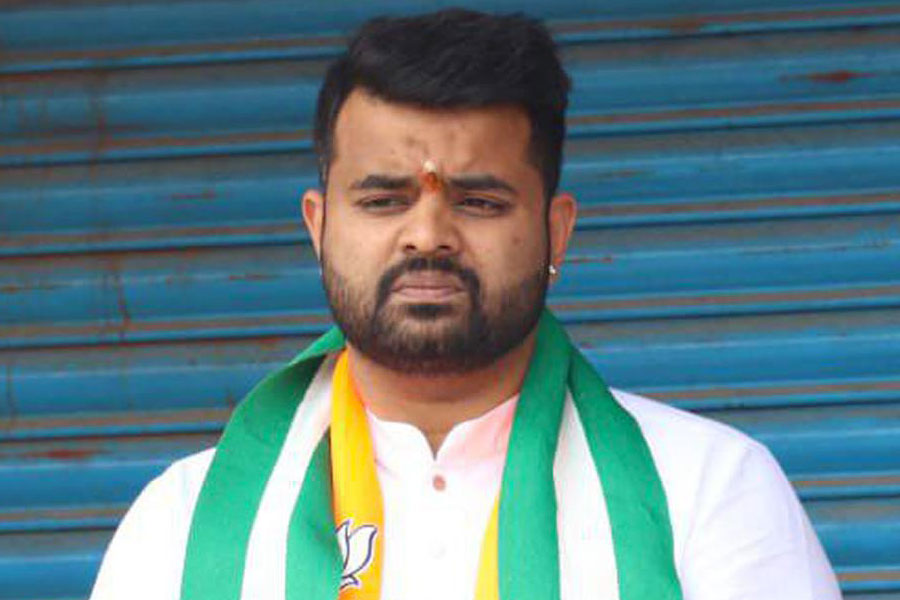
Prajwal Revanna.: File picture.
K.M. Rakesh, TT, Bengaluru, 28.05.24 : Janata Dal Secular MP Prajwal Revanna on Monday released a video announcing he would return to India and, at 10am on May 31, appear before Karnataka police’s special investigation team that is probing sexual abuse allegations against him.
Prajwal, 33, who is seeking re-election from his Hassan Lok Sabha constituency, had flown abroad just as the accusations against him became public, triggering allegations that he was fleeing justice.
“I will appear before the SIT on May 31 at 10am and fully cooperate with the investigation,” Prajwal, grandson of JDS patriarch and former Prime Minister H.D. Deve Gowda, says in the video.
“I am confident of coming out clean against these false allegations through the courts, since I have complete faith in the judiciary.”
It appears unlikely that Prajwal would have the chance to appear before the SIT by himself. A city court issued an arrest warrant against him on May 18, which would enable the SIT to detain him at the airport itself.
Prajwal has not, however, revealed his flight details or his current location. His father and Holenarasipura MLA, H.D. Revanna, has said Prajwal flew to Germany on a prescheduled trip.
A former domestic help of Prajwal has accused him of sexual abuse. Father and son are also accused of having abducted her to intimidate her against accusing Prajwal.
The SIT probing Prajwal is also investigating pen drives containing 2,976 files — including video clips and pictures of suspected sexual abuse of multiple women — that were found discarded in Hassan just days before the April 26 election there. While the Opposition has alleged the man in the clip is Prajwal, the SIT hasn’t yet officially confirmed it.
Prajwal begins the nearly three-minute video message saying: “I apologise to my parents, grandfather, my Kumaranna (uncle and former chief minister H.D. Kumaraswamy), the people of my state and all the party workers.”
He claims he had no idea about the charges against him until a few days after leaving Bengaluru, which he did early on April 27.
“There was no case against me when the election was held on April 26. There was no SIT, either. My overseas trip on April 26 was already planned,” he says. “Three or four days after I reached overseas, I happened to see news on YouTube about this.”
He says he sought seven days from the police to respond, contacting the force from abroad through his lawyer, but slipped into depression after the allegations were widely discussed in public forums.
“But even after that (his May 1 tweet saying he had sought time from the police) Congress leaders including Rahul Gandhi started discussing this issue in open forums. I slipped into depression and went into isolation,” he says.
Prajwal’s announcement comes after repeated appeals to him from Deve Gowda and Kumaraswamy to return and face the law.
In a public statement on X recently, Deve Gowda had warned Prajwal that he would have to face the anger of his family if he did not return to India.
PTI & Agencies, New Delhi, May 27, 2024 : The Supreme Court on Monday refused to entertain a plea filed by the BJP challenging a Calcutta High Court order that had refused to interfere with a single-judge verdict restraining the party from issuing advertisements that are allegedly violative of the model code during the Lok Sabha polls.
A vacation bench of Justices J K Maheshwari and K V Viswanathan refused to interfere with the high court order.
“Prima facie, the advertisement is disparaging,” the bench said.
Senior advocate P S Patwalia, appearing for the BJP, sought permission to withdraw the matter after the bench expressed disinclination to entertain the matter.
The matter was dismissed as withdrawn.
On May 22, a division bench of the high court had said it was not inclined to entertain the appeal against the interim order passed by the single-judge bench.
The single-judge bench on May 20 had restrained the Bharatiya Janata Party (BJP) from publishing advertisements that violated the MCC until June 4, the day the Lok Sabha poll results are scheduled to be declared.
The court had also restrained the saffron party from publishing the advertisements mentioned by the ruling Trinamool Congress (TMC) in West Bengal, in its petition claiming unverified allegations against it and its workers.
The two-judge bench of the HC, headed by the Chief Justice T S Sivagnanam and also comprising Justice Hiranmay Bhattacharyya, refusing to grant any relief to the BJP, directed that the party should not to publish any advertisement violating the MCC during the Lok Sabha election process.
While refusing to interfere to the single-judge bench order, the two-judge bench had observed that all political parties needed to follow healthy electoral practices, as the ultimate victim of misleading electoral campaigns was the voter.
The division bench also observed that a “Laxman Rekha” should be adhered to, and added that there should not be any personal attack on the part of any political party.
The order had been passed by the single-judge bench, after hearing a petition filed by TMC to restrain the BJP from carrying such ads. The TMC had objected to certain ads published by the BJP in certain newspapers against the Mamata Banerjee- led party.
This single-judge order was challenged by the BJP in the two-judge bench of the HC, which also refused to entertain BJP’s prayers on May 22.
A vacation bench of Justices J K Maheshwari and K V Viswanathan refused to interfere with the high court order.
“We have seen the advertisements. Prima Facie, the advertisements are disparaging. We don’t want to lend our hands to promote further acrimony,” the two-judge vacation bench of the top court, led by Justice J K Maheshwari and Justice KV Viswanathan said.
The top court further remarked that such ads will not help the voter. It asked senior advocate P S Patwalia, appearing for the appellant party (BJP) not to precipitate the matter, saying the advertisement was not in the interest of voters and the rival party was not your enemy.
After hearing these remarks and observations from the top court, Patwalia then preferred to withdraw the petition, saying he would prefer to file a reply before the High Court’s single judge bench which passed the interim order.
Earlier on, May 24, mentioning the matter before the two-judge vacation bench of the top court, led by Justice Bela M Trivedi and Justice Pankaj Mithal, senior advocate Saurabh Mishra, for the BJP, sought urgent hearing into the case.
The judges of the top court, did not fix any date to hear the case, but said, “We will see it.”
Initially, on May 20, the Calcutta HC’s single-judge bench of Justice Sabyasachi Bhattacharyya, in its order had restrained the BJP from publishing such ads until further orders, after finding the advertisements in question to be in violation of the MCC.
Justice Bhattacharyya, in his order, had also pulled up the Election Commission of India (ECI) for “grossly failing” to address the complaints filed by the TMC against BJP advertisements that targeted the ruling party in West Bengal.
The plea said the chief minister is required to undergo some medical tests and for this purpose, the interim bail, which is ending on June 1, be extended
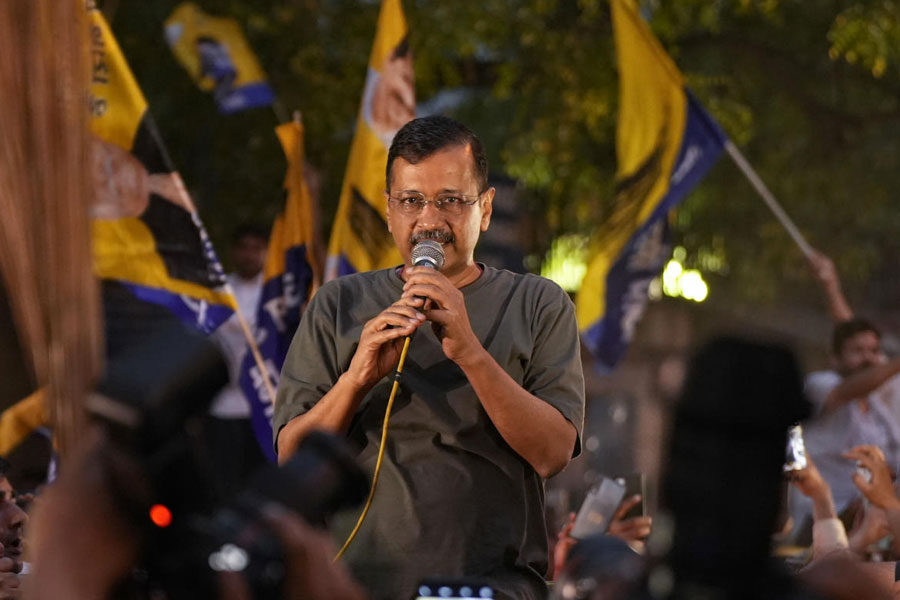
Arvind Kejriwal: FilePTI, New Delhi, 27.05.24 : Ahead of his scheduled return to jail on June 2, Delhi Chief Minister Arvind Kejriwal has moved the Supreme Court seeking extension of his interim bail by seven more days on grounds that he has to undergo some medical tests, including a PET-CT scan.
The top court had on May 10 granted 21-day interim bail to the chief minister, who was arrested in a money laundering case linked to the excise policy scam, to enable him to campaign for the Lok Sabha polls.
It had directed that Kejriwal shall surrender on June 2, a day after the last phase of the seven-phase poll gets over.
The chief minister, in his fresh plea filed on May 26, has sought extension of the interim bail by seven more days on health grounds, including that he has lost seven kgs and that his ketone levels are “too high”, a possible indicator of a serious ailment.
The plea said the chief minister is required to undergo some medical tests including a PET-CT scan, and that the interim bail, which is ending on June 1, be extended. PET-CT scan shows detailed pictures of organs and tissues.
While setting him free for campaigning in the remaining phases of the Lok Sabha elections after 50 days of custody in the case, the court had barred him from visiting his office or the Delhi secretariat, and signing official files unless absolutely necessary for obtaining the lieutenant governor’s approval.
While imposing a strong of bail conditions on Kejriwal, the apex court had directed him to furnish bail bonds of Rs 50,000 with one surety of the like amount to the satisfaction of the jail superintendent.
A bench of Justices Sanjiv Khanna and Dipankar Datta had rejected the argument of the Enforcement Directorate (ED) counsel that enlarging Kejriwal on interim bail to campaign in the elections will be without a precedent.
The matter relates to alleged corruption and money laundering in the formulation and execution of the Delhi government’s now-scrapped excise policy for 2021-22.
The Enforcement Directorate, on October 30, last year, had sent first summons to Kejriwal in the money laundering case for appearance on November 2, 2023. Several summons were also issued subsequently.
On March 21, the Delhi High Court refused to grant him protection from arrest on his petition challenging summonses issued to him. The ED arrested Kejriwal shortly after that.
The matter relates to alleged corruption and money laundering in the formulation and execution of the Delhi government’s now-scrapped excise policy for 2021-22.
Golay and Thapa were invited by the Rai community for their Sakela Ubauli festival in Darjeeling on Sunday
Sikkim chief minister PS Tamang (Golay) greets people with folded hands, accompanied by GTA chief Anit Thapa (right) at the Kirat Khambu Rai Sanskriti Sansthan’s Sakela festival in Darjeeling on Sunday: Picture by Passang Yolmo
Vivek Chhetri, TT, Darjeeling, 27.05.24 : Sikkim chief minister Prem Singh Tamang (Golay) and the chief executive of the Gorkhaland Territorial Administration (GTA) Anit Thapa shared a dais at a public forum for the first time on Sunday.
Both Nepali-speaking leaders expressed their commitment to work together on community issues, keeping aside their political differences.
While Golay is aligned with the BJP, Thapa, who also heads the Bharatiya Gorkha Prajatantrik Morcha, backs the Trinamool Congress.
Golay and Thapa were invited by the Rai community for their Sakela Ubauli festival in Darjeeling on Sunday.
The two leaders walked together in a rally from near Darjeeling railway station to Chowrasta and shared the stage where both stressed the need to work together to get tribal status for the left-out Gorkha communities.
Golay reminisced his college days in Darjeeling from 1985 to 1989, when the hills were burning during the Gorkhaland agitation. He told the crowd how he also had to flee during police raids during the middle of the night.
“Today (Sunday), I have been invited as a chief minister of Sikkim and this is a huge honour for Sikkim too…. Politics is in its own place and we would not want to interfere, but we in Sikkim and Darjeeling also share very close cultural, community ties. We must work together on raising certain community-centric issues,” said Golay.
The Sikkim chief minister specifically pointed out the tribal status issue. “We must work together on tribal issues. While there are 11 communities in Darjeeling, there are 12 communities in Sikkim (demanding Scheduled Tribe status). We must work together and take this issue forward,” said Golay.
In Darjeeling, the 11 communities demanding ST status are Bhujel, Gurung, Mangar, Newar, Jogi, Khas, Rai, Sunuwar, Thami, Yakka (Dewan) and Dhimal. The Maji community in Sikkim is its twelfth.
The Sikkim chief minister stated that issues like the inclusion of the Nepali language in the Eighth Schedule of the Constitution succeeded when leaders of Sikkim and Darjeeling joined hands. Sikkim MP Dil Kumari Bhandari played a pivotal role in getting Nepali recognised in 1992.
Thapa, who spoke before Golay, said that the entire Nepali-speaking community must be proud of Golay.
“He is the only chief minister from our community and we must be proud of this fact,” said Thapa.
The GTA chief executive also requested Golay to take forward the tribal issue. “Politics is in its place. We can work (together) on our own issues. I request Golay sahib to take the lead on this issue,” said Thapa.
The BJP in its 2019 Lok Sabha poll manifesto promised a tribal status to the 11 Gorkha communities but in vain. There was no mention of it in the party’s 2024 manifesto.
Golay said a help desk was being set up in Gangtok hospitals for patients from outside Sikkim.
“Sikkim’s health facilities have improved a lot. Many patients from this region are coming to Sikkim. Medical expenses are one-fourth in Sikkim compared to private nursing homes in Siliguri,” said Golay. “We are setting up help desks for patients coming from outside the state.”
Radhamadhab Saha, MP, 26 May 2024, Raiganj: With more than three-and-a-half-months having passed since four children died after being buried alive in an under-construction high drain at Chetnagauchh in Chopra, North Dinajpur, the affected families are yet to receive Rs 1 lakh ex-gratia each assured by C V Anand Bose, Bengal Governor, during his visit.
The affected families have expressed their grievances and appealed to the Governor to live up to his commitment. Close to Dangi border outpost in Chopra, manned by the BSF, a high drain was being dug up with a JCB, without any precautionary measures.
Four children between 6 and 11 years of age died from a mudslide from the construction of this high drain on February 12. Also Read – Cyclone ‘Remal’: Civic bodies take prep measures to tackle impact
On February 19, Chandrima Bhattacharjee, minister of state in-charge of the Finance and Health department as well as the state TMC leaders met the bereaved families and declared Rs 2 lakh compensation from the end of the state government to each victim’s family.
She also announced Rs 3 lakh to each family from the end of the TMC committee. The families received both the amounts. Samirul Islam whose child died in this incident, said: “We have received the ex-gratia from the state government and TMC committee.
The Governor had assured us an assistance of Rs 1 lakh to each family. However, even after over three months, we have not received the fund yet.”
Kanaiyalal Agarwal, president of North Dinajpur TMC committee, said: “The four families are from the economically backward bracket. We urge the Governor to pay them as per his commitment.”
Amitava Banerjee, MP, 26 May 2024, Darjeeling: Sikkim Chief Minister Prem Singh Tamang and Gorkhaland Territorial Administration (GTA) chief Anit Thapa unanimously stated that they would work together for issues benefiting the Gorkha community.
The issue pertaining to the inclusion of the 11 Gorkha sub-communities in the Scheduled Tribe list would be pushed by both. Sharing the stage for the first time, Tamang and Thapa attended the Ubhauli Sakela festival of the Kirat Rai community, in Darjeeling, on Sunday.
Both took part in a colourful procession from Darjeeling Railway Station to Darjeeling Mall. “In the capacity of the Chief Minister of a state, the Gorkha community looks up to you as their guardian.
We request you to take up issues concerning the Gorkhas, especially the inclusion of the 11 Gorkha sub-communities in the Scheduled Tribe list. You have to lead us. Whenever there is an issue pertaining to the welfare of the Gorkhas, Chief Minister P S Tamang will always find me by his side.
Keeping aside politics we will all have to work together for our community,” stated Anit Thapa.
Speaking in unison, the Sikkim Chief Minister stated: “Places have their own politics, Sikkim has its politics, Darjeeling has its own politics and so does Bengal. We do not interfere in each other’s politics.
However, for the issues concerning all of us, we have to work together.
In the case of inclusion of Nepali language in the 8th Schedule of the Indian Constitution or inclusion of Limboo and Tamang communities in the Schedule Tribe list, both the states had worked together. Similarly regarding the inclusion of the left out Gorkha sub-communities in the ST list we have to work together.
Already Sikkim and Bengal have sent recommendations to Delhi,” stated Tamang. Tamang stressed on Sikkim and Darjeeling being neighbours. “Neighbours always help each other. In times of crisis, neighbours are the first to extend a helping hand. Likewise, staying away from politics we should always help each other,” stated Tamang.
The Sikkim Chief Minister stated that Sikkim was fast emerging as a medical and education hub. “Many from the Darjeeling and Kalimpong Hills come to the government hospital in Gangtok for specialised treatment. It is much cheaper than private facilities in Siliguri. Soon we will start a help desk at the hospital for the benefit of outstation patients,” stated Tamang.
The two-day festival was organised by the Kirati Khambu Rai Sanskritik Sanghsthan, Darjeeling on May 25 and 26 at the Darjeeling Mall, attended by people from Darjeeling, Kalimpong, Sikkim and Dooars.
The Rai’s are an ethno-linguistic group of the Kirat family residing in Bengal and Sikkim in India along with eastern Nepal and south western Bhutan. Sakela Ubhauli is a harvest festival and is celebrated in the month of Baisakh welcoming spring and starts on the full moon day. Courtesy & source- Millennium Post