All posts by Kalimpong News

Raju Bista wins by 178525 votes in Darjeeling, promises justice for Gorkha people

Bista -178525 (51.18%), Lama- 500806 (37.73%): In comparison to result of Parliamentary election of 2019 its 7.9 % decrease to BJP and 11.22% increase to AITC.

EOI, DARJEELING, JUNE 4, 2024 : The sitting BJP MP from Darjeeling, Raju Bista retained his seat for the second term defeating Trinamool Congress candidate Gopal Lama by a margin of over 100,000 votes, at the end of counting, on Tuesday. 

The trend was set after the first round of counting, with Bista leading Lama by over 10,000 votes in the plains segments and by over 5000 votes in the hills constituencies. 
The Darjeeling constituency comprises the hill segments of Darjeeling, Kalimpong and Kurseong, while Siliguri, Matigara-Naxalbari, Phansidewa and Chopra make up the plains segments. 
In the Darjeeling assembly segment, the BJP got 87,062 votes and the Trinamool 55,736 votes, in Kalimpong the BJP got 77,524 votes and the Trinamool got 53,743 and in Kurseong the BJP got 93,419 votes while the Trinamool got 55,068 votes. 
The BJP is in alliance with the Gorkha National Liberation Front, Gorkha Janmukti Morcha, Communist Party of Revolutionary Marxists, Gorkha Rastriya Nirman Morcha and the SUMETI Morcha. 
Before heading for the counting centre at the Darjeeling Government College in the morning, Bista visited the revered Mahakal temple at Chowrasta to offer prayers. 
After the announcement of his victory, Bista said it was a victory of the people of the Hills, Terai and Dooars and their aspirations. 
“This victory is for the people and to bring to end the atrocities of Bengal and development of the hills. I thank the people for showing their trust on me and Prime Minister Narendra Modi,” he said. 
Bista first visited GNLF president Mann Ghising at his residence where supporters burst crackers. Bista then went to meet GJM president, Bimal Gurung in the latter’s party office with supporters rejoicing the victory with song and dance on the street. 
“I thank Bimal daju and Ghising ji and all our alliance partners for their support. Now my vision and goal is clear. I gained experience in the past five years. And now will go to parliament with renewed vigour and energy. The Gorkha community will get justice within the next five years,” he said. 
According to the data available in the portal of the Election Commission of India at the time of writing this report, 6,46,519 votes were polled in favour of Bista and 4,88,098 votes for Lama with a victory margin of 1,58,421 votes for the former. 
In the 2019 Lok Sabha election, Bista won by a record margin of over 4.13 lakh votes against the Trinamool Congress-GJM (Binoy Tamang faction) combine candidate Amar Singh Rai. Surprisingly, Bista won by an impressive margin from Kurseong which is the home ground of the Bharatiya Gorkha Prajatantrik Morcha chief Anit Thapa who heads the Gorkhaland Territorial Administration and is the key ally of Trinamool in the hills. 
The GJM president said there was a lot of work for the BJP to do for the community and that he would keep reminding Bista. 
“The demand for tribal status will be given priority. We will keep pressuring Bista and the BJP to fulfill this demand as early as possible. There are lots of other work to do for the hills and Terai people,” said Gurung. 
In its 2019 Sankalp Patra, the BJP had promised to find a permanent political solution for the hills and grant tribal status to the 11 left out Gorkha communities, which has not been fulfilled, yet. 
The BGPM president congratulated Bista on his victory and said in democracy the mandate of the people had to be accepted. 
“We tried a lot to bring about a change in the mindset of the people but failed. People have voted for the BJP and we have to accept their mandate. Now for 20 years people have voted for the BJP and expect results. I want to congratulate Bista and hope he will work the people,” he said.

Alert to avert deaths, losses: Sikkim and Bengal governments keep watch on rainfall and Teesta

 On one hand, they have initiated round-the-clock monitoring of rainfall and surge in water levels to pass alerts in advance
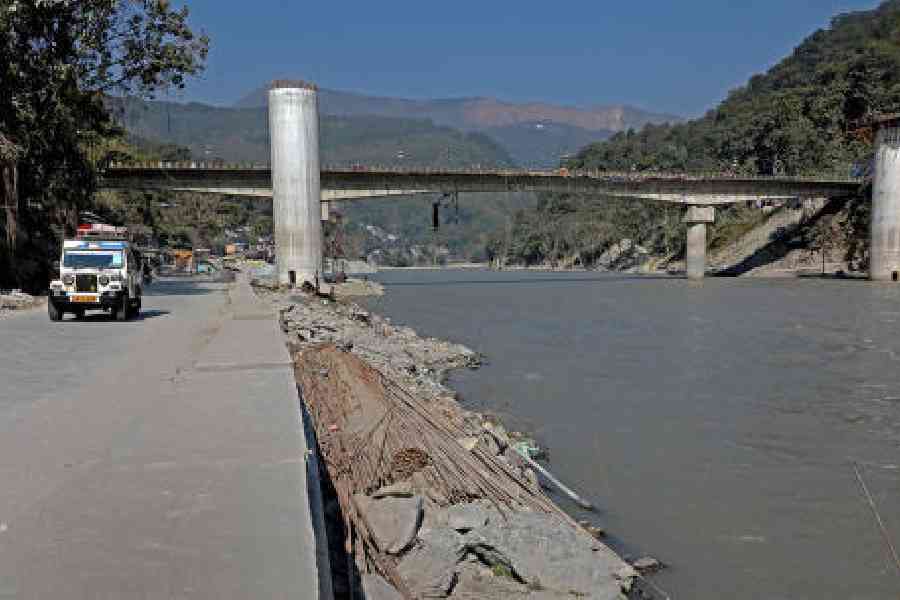
The Teesta river near Teesta bazar: File picture

TT Bureau, Siliguri/Jalpaiguri, 04.06.24 : The Bengal irrigation department and the Sikkim government have swung into alert mode at the onset of the southwest monsoon in the sub-Himalayan region and particularly after last year’s flash flood on the Teesta river.

On one hand, they have initiated round-the-clock monitoring of rainfall and surge in water levels to pass alerts in advance.
On the other hand, they have taken initiatives to mitigate the loss of lives and property in case there is a flash flood due to incessant downpours. Over the past few days, it has rained heavily in a number of areas of Sikkim and sub-Himalayan Bengal.

On June 1, the irrigation department opened a Supervisory Control & Data Acquisition (SCADA) room in Jalpaiguri. It will work round the clock throughout the monsoon months to gather data on rainfall and rise in water levels of the Teesta and other rivers through automated rain gauge stations and satellite, said Krishnendu Bhowmik, the chief engineer (northeast) of the department.

According to him, in sub-Himalayan Bengal and Sikkim, data on rainfall and water levels of rivers are collected from 30 rain gauges of the regional Met office of Gangtok, 28 rain gauges of the central water commission and 12 rain gauges of the Bengal irrigation department which have been installed in different locations of the region.

The official mentioned that due to the flash flood which occurred in the Teesta in October last year because of the outburst of South Lhonak Lake, there had been huge deposition of silt and debris downstream.

“As a result, the river bed has risen by one-and-half metres. If it rains heavily along the Teesta catchment areas of the hills and plains, there is a risk of flash flood. That is why we are putting all efforts to gather information in advance so that people living closer to the banks and in low lying areas, can be shifted in advance,” said Bhowmik.

This year, the department has also decided to issue primary (yellow) and secondary (red) alerts along both banks of the Teesta before the water level touches the necessary mark.

“As the river bed has increased, it is evident that the river will swell in a short time during the monsoons. Thus, the alerts would be issued in advance,” Bhowmik added.

Ahead of the monsoons, the department has carried out maintenance and repair works in the banks to prevent breach of embankments.

“However, for the long-term solution, we have to wait for completion of the survey that is being conducted by the River Research Institute (headquartered in Haringhata of Nadia). Only then, plans can be drawn for flood control,” said the official.

Meanwhile, in Sikkim, senior officials of Namchi and Pakyong districts, which are in the southern parts of the mountain state, have visited a number of locations which are on the banks of the Teesta to check out the situation.

“Last week, joint inspections were conducted in Melli, Rangpo Mamring, Adarsh Gaon, Balutar and some other areas to assess the situation. Some vulnerable spots have been identified and instructions were given to carry out immediate restoration works,” said a source.

The state water resources department has been directed to take preventive measures erecting Gabion baskets along the river bank to prevent flooding.

“To ensure that people don’t venture into vulnerable areas, the spots would be barricaded with red ribbons by local authorities. Further, official instructions have been passed to restrict access of people to areas on the Teesta river bank which can cave in because of rise in water levels,” the source added.

As a part of preventive measures, the forest department of Sikkim has mandated closure of quarries after 5pm to ensure the safety of workers.

“The Met office, state department and central agencies are regularly exchanging information to act well in advance,” said a source

Sikkim prod on travel agents, tourists advised to plan trips through registered centres

The advisory, which was issued by Bandana Chhetri, an additional secretary of the department on Monday, mentioned that they have received complaints regarding fraudulent online travel agencies from tourists

TT Correspondent, Siliguri, 04.06.24 :  The tourism and civil aviation department of Sikkim has issued an advisory for tourists, asking them to plan their trips only through travel agencies which are registered with the department.

The advisory, which was issued by Bandana Chhetri, an additional secretary of the department on Monday, mentioned that they have received complaints regarding fraudulent online travel agencies from tourists.
“To avoid such complications, it is advised that tourists intending to visit Sikkim should get their bookings done or plan their trips only with agencies which are registered with the department. The list of such agencies is available in the department’s website (www.sikkimtourism.gov.in),” said a source.

The selection of such agencies would also ensure the safety of tourists and they can have a satisfactory trip to the mountain state. “It will also mitigate the risk of falling victim to scams,” the source added.

Along with the advisory, the department has also published a list of 18 officers and employees of the department. They have been deputed as nodal officers in the six districts of Sikkim – Gangtok, Mangan, Pakyong, Namchi, Soreng and Gyalshing – to resolve tourism related grievances.

“This will help in resolving tourism related issues in a prompt manner. If required, the nodal officers can communicate with senior officials of the department to redress any issue,” said a source.

As per the data available with the department, 6,33,266 domestic tourists have visited the state from January to May 26 this year while 46,697 foreign tourists had been to Sikkim till April this year.

“The number of foreign tourists is on the rise in Sikkim over the past few years as in 2018, the restriction on Bangladeshi tourists has been withdrawn. Hundreds of Bangladeshis, who would earlier go to north India to enjoy a trip at the hill station, are swarming in Sikkim now,” said Debasish Chakraborty, general secretary, Eastern Himalaya Travel & Tour Operators’ Association.

Those associated with the industry however pointed out that road conditions should be improved in northern parts of the state.

Election Commission proposes bypoll schedule for Maniktala Assembly seat in Bengal

Sadhan Pande of the Trinamool Congress had won from Maniktala in 2021 and he passed away in February 2022

R. Balaji, TT, New Delhi, 04.06.24 : The Election Commission on Monday submitted a report in a sealed cover to the Supreme Court on the proposed schedule of the bypoll for the Maniktala Assembly seat in Bengal.

Sadhan Pande of the Trinamool Congress had won from Maniktala in 2021 and he passed away in February 2022.

Pande’s win had been challenged by rival BJP candidate Kalyan Chaubey through an election petition in Calcutta High Court. In view of the election petition, a bypoll couldn’t be conducted and the constituency has been unrepresented.

Suvendu Dey, a local voter, moved the Supreme Court for a direction to the EC to hold the bypoll.

On May 18, the court gave the last opportunity to the Election Commission to place before it the Maniktala bypoll schedule.

When the matter came up for hearing on Monday, the EC’s counsel submitted a report on the byelection schedule to the bench of Justice Prashant Kumar Mishra and Justice K.V. Viswanathan. The EC told the court that the report was in the sealed cover because of the model code of conduct in force.

Justice Viswanathan then said in view of the schedule fixed by the EC, the matter ought to be given a quietus.

Accordingly, the court disposed of the matter, saying no further orders were required to be passed.

Siliguri civic body initiates steps to prevent water crisis

Sanchita Aich Bag, MP, 3 June 2024, Siliguri: Taking a cue from the recent problem of drinking water supply in the city during the repair of the Teesta Dam in Gajoldoba, the Siliguri Municipal Corporation (SMC) has initiated steps to prevent a rerun of such a situation. 

After getting instruction from Chief Minister Mamata Banerjee, the board is going to restart work on the Mahananda Action Plan after the election results are declared. 
Under this plan, the Mahananda River will be cleaned and purified with three Sewage Treatment Plants (STP) I, II and III. The Kolkata Metropolitan Development Authority (KMDA) will do the work. 
On Monday, a meeting was held with the members of KMDA, where the Commissioner of SMC and other officials were present. Along with this, a unit to test drinking water will also be set up in Siliguri, said a SMC source. 
“The past board of SMC did not install an alternative intake well. They also did not execute the Mahananda Action plan. However, we have undertaken these works. The alternative intake well in Fulbari will be installed within this month. 
Tender process for the work of STP will take place immediately after the election results are declared,” said Gautam Deb, Mayor of Siliguri. In 2004, Ashok Bhattacharya, the then minister of Municipal Affairs had announced the Mahananda Action Plan. 
The Siliguri Jalpaiguri Development Authority (SJDA) started the work. However, the work was halted due to the embezzlement of Rs 200 crore. 
As part of the plan, construction work on two STPs in the Noukaghat area had started. However, the work was later stopped. In 2022, when Trinamool came to power in the SMC board, they began working on restarting the project. 
By the end of 2023, the Mayor restarted the work of an STP, for which Rs 255 crore was sanctioned. 
However, the work could not be started due to a failure in the tender call. A re-tender will be called.The Mayor also said that the SMC will install six deep tubewells in different areas of the city. 
The Public Health department (PHE) is planning to set up a water testing unit in Fulbari, said an SMC source. Currently, the Biochemical Oxygen Demand (BOD) test is done in Kolkata. It takes around five days to get the report. 
Courtesy & source: Millennium Post
https://www.millenniumpost.in/bengal/siliguri-civic-body-initiates-steps-to-prevent-water-crisis-566431

Temp likely to go up by 30 Celsius before Friday, says weatherman

MP, 4 June 2024, Kolkata: The Regional Meteorological Centre in Alipore has predicted that the temperature may go up by 3 degree Celsius before Friday. 

Discomfort will prevail in South Bengal districts. Southwest monsoon has entered North Bengal but it remained stationary in the same spot for nearly three days. 
A low pressure has formed in south east Bay-of-Bengal Western disturbances will enter north west parts of the country on Tuesday. 
The city on Monday registered its lowest temperature at 27.9 degree Celsius while the highest temperature of the day was registered at 34.4 degree Celsius in Kolkata on Sunday. 
The Regional Meteorological Centre in Alipore had predicted scattered rainfall may happen in several parts of South Bengal. 
Yellow alert had been issued for the districts like North and South 24-Parganas, East Midnapore, Birbhum, Murshidabad and Nadia which would receive moderate to heavy rainfall on Tuesday, on the day of election counting. 
A gusty wind of 40-50 kmph may be sweeping through the regions. The MeT office said that rains will continue in South Bengal till Tuesday while there is a heavy rain forecast in the North. Kolkata, however, will continue to experience dry weather. 
After 15 years, Bengal has witnessed the entry of monsoon rains in the month of May this year. 
The state had registered a similar situation in 2009 when the monsoon entered north Bengal on May 25. In 2006 and 2007, monsoon entered North Bengal in May. Monsoon entered North Bengal on May 31 this year. 
But the pre-monsoon season is going on in the south. The normal monsoon onset date for Kerala is June 1 and for Arunachal Pradesh, Tripura, Nagaland, Meghalaya, Mizoram, Manipur and Assam is June 5. 
According to weather scientists, El Nino conditions are prevailing at present and La Nina may set in by August-September. 
https://www.millenniumpost.in/bengal/temp-likely-to-go-up-by-30-celsius-before-friday-says-weatherman-566467

Swelling lakes in Tibet due to climate change could cause heavy losses for China

PTI, Beijing, Jun 3, 2024 : Numerous lakes in Tibet dotting the picturesque Himalayan region are set to swell with billions of tonnes of water due to increased rainfall caused by climate warming and the melting of glaciers which could cause massive economic losses for China, a study by a group of international scientists has said.

     
By the end of the century, the surface area of some lakes in the Qinghai-Tibet Plateau could increase by more than 50 per cent with the water volume of the lakes in the plateau estimated to expand by more than 600 billion tonnes, according to the study published in the peer-reviewed journal Nature Geoscience last month.
     
If these predictions are correct, the researchers said it could have a massive economic impact on China, running into the billions of dollars, the Hong Kong-based South China Morning Post reported on Monday, quoting the study’s findings.
     
“Our results suggest that by 2100, even under a low-emissions scenario, the surface area of endorheic lakes on the Tibetan Plateau will increase by over 50 per cent (around 20,000 sq km or 7,722 sq miles) and water levels will rise by around 10 metres (32 feet) relative to 2020,” the study said.
     
Endorheic lakes, also known as closed lakes, do not have an outlet to drain into.
     
The scientists from China, Wales, Saudi Arabia, the United States and France said this would correspond to a four-fold increase in water storage compared to what the area experienced over the last 50 years.
     
If steps are not taken to mitigate this, “more than 1,000 km of roads, approximately 500 settlements and around 10,000 sq km of ecological components such as grasslands, wetlands and croplands,” will become submerged, the study said.
     
Observers say that the swelling lakes and melting glaciers could also impact neighbouring countries including India as Tibet is the origin of several rivers including the mighty Brahmaputra.
     
The Qinghai-Tibet Plateau, known as the “Water Tower of Asia”, is the highest and largest plateau in the world and is home to more than 1,000 lakes with large reserves of water in both liquid and ice form.
     
“[It is] one of the regions that is most vulnerable to climate change acting as an early warning signal for the wider effects of global warming,” the researchers wrote.
     
China has invested billions of dollars in developing rail, road, and aerial infrastructure in the remote region to consolidate its hold over the strategically important Himalayan region.
     
While large lakes in other parts of the world have been experiencing a decline in water storage due to rising temperatures and human activity, lakes in the plateau have been expanding in recent decades due to warmer and wetter conditions, the study said.
     
Increases in net precipitation have mostly driven this. While melting glaciers also contribute to this phenomenon, the researchers said the remaining glaciers have “limited storage”.
     
Despite the northern parts of the plateau being projected to experience the largest increase in water storage, roads in the northeast, where there is more human activity and infrastructure, will be the most vulnerable to inundation.
     
Looking at the researchers’ middle socioeconomic scenario, the study estimated that inundated roads could directly lead to an economic loss of 20 billion yuan to 50 billion yuan (USD 2.7 billion to USD 6.9 billion) by the end of the century.
     
This “is a serious threat that should be considered in future rail and road planning”, the study said.

SKM urges SDF leaders, workers not to flee Sikkim fearing persecution

PTI, Gangtok, Jun 3, 2024 : After social media posts claimed that demoralised SDF leaders and workers were fleeing Sikkim following assembly poll defeat, fearing attacks by ruling party cadre in post-poll violence, the Sikkim Krantikari Morcha (SKM) on Monday urged them to stay back, promising peace and security for all.

    
The SKM bagged 31 of the 32 assembly seats, the results of which were declared on Sunday. The SDF managed to win only one seat and even its party supremo and five-term former chief minister Pawan Kumar Chamling lost both the seats he contested.
    
“Dear esteemed leaders and supporters of the SDF party, we have come to learn that many of you have left Sikkim fearing potential attacks. We wish to emphasise that the SKM, once a victim of such violence, deeply understands the pain caused by these heinous acts. Our ethos strongly stands against indulging in any form of violence,” SKM spokesperson Jacob Khaling said in a statement.
    
He said Chief Minister Prem Singh Tamang has strictly instructed all party workers to abstain from any anti-social activities in Sikkim.
    
“We have vowed to maintain peace and harmony across our beloved state,” Khaling said, urging those SDF workers and leaders who have fled the state to return.
    
The main opposition party must continue to engage with the public and continue public work to contribute to betterment of the people of Sikkim, the SKM leader said.
    
Even the chief minister, in a statement issued a few days back, batted for peace and security in Sikkim during the second SKM term.

    
SDF leaders could not be reached for their comment on the development.

Important to critique, record and lift veil from journalism: Ravish Kumar

The documentary records Ravish’s last months in NDTV India where he constantly battled staff exodus, doxing, abuse and death threats during the course of his anchoring and reporting.
PTI, New Delhi, Jun 3, 2024 : If a housing society starts to collapse, people start looking for better options and move out, says journalist aThe documentary records Ravish’s last months in NDTV India where he constantly battled staff exodus, doxing, abuse and death threats during the course of his anchoring and reporting.nd YouTube star Ravish Kumar about the debate over the decline of mainstream media and the rise of alternatives.
     
The schisms between different kinds of journalism and alternative platforms that have come up in the last few years are no longer a matter of discussion just for media insiders. From village squares to big city drawing rooms, the issue has been dissected thoroughly, more so in these elections. And, according to Ravish, this is being recorded whether through documentaries or song.
     
The journalist, who has over 10 million followers on his YouTube channel and is considered a trailblazer, is also the central protagonist of Vinay Shukla’s riveting 2022 documentary “While We Watched”.
     
“If a housing society starts to collapse, people start moving to a better one. It is not like it is no longer needed. Which is why you will find the reflection of the times in many films, songs and in other ways,” Ravish told PTI in an interview.
     
“I don’t see this documentary as the story of one journalist. I can’t even see myself in it. I see different things, sometimes I remove myself and imagine a female protagonist or a journalist like Siddique Kappan (who spent two years in jail) and the story starts to appear more horrific,” he said.
     
Vinay’s documentary, which has fans such satirist-host John Oliver, won a Peabody award last month. It records Ravish’s last months in NDTV India where he constantly battled staff exodus, doxing, abuse and death threats during the course of his anchoring and reporting.
     
The 49-year-old, one of the most recognised faces in Hindi journalism, said he sees the documentary as a sort of “intervention” as it focuses on recording the near beginning of the crisis in his profession.
     
He said people in journalism know the decline it has suffered and how the larger picture is disturbing.
     
“Many have stopped watching news on television and they are searching for alternative mediums. I am not going into the merits or disadvantages of the alternative medium but the work that’s being done… for example, people who worked on the story of electoral bonds, were from alternative media,” he said, adding that he worries about new journalists joining mainstream journalism.
     
“Vinay keeps saying that more than one film is needed to record this process in depth,” he said, giving the example of senior journalist Paranjoy Guha Thakurta’s songs on ‘Godi media’, a term that has come to be associated with those supporting the government.
     
“… most senior journalists, what are they doing? Their work is mostly the critique of the profession… At least, it is being recorded which is a good thing. It was time to lift the veil from this profession and I am sure something good will come out of it,” he added.
     
Vinay, whose documentary is streaming on MUBI India, likened it to “Titanic”. Instead of this being the story of Jack and Rose (Leonardo DiCaprio and Kate Winslet), his protagonists are the musicians who went down with the ship playing their violins.
     
“Making this film was heartbreaking for me. This film is a love letter to journalists and the profession, but not to the legacy media. Some people keep obsessing that this has happened in the last 10 years but I would say that this process began much earlier, it just became fast in the last decade,” Vinay said.
     
In November 2022, Ravish left NDTV India after the company changed hands and went on to start his own YouTube channel.
    
Vinay, who with Khushboo Ranka has previously documented the rise of Arvind Kejriwal’s Aam Aadmi Party in his 2016 documentary “An Insignificant Man”, shadowed Ravish for more than a year, capturing him at his job, saying goodbye to his colleagues one by one, writing, anchoring and worrying about his relevance.
     
“Those cake cutting scenes (when journalists were leaving the organisation) are humorous but also heartbreaking… I wanted people to know that tragedy happens in today’s time while a chocolate cake is being served,” Vinay said.
     
The filmmaker said he was curious about the world of journalism and wanted to show the nuts and bolts of the profession today. “The people who are still in it and trying to do their work honestly, how it is becoming increasingly hard for them,” he said.
     
Ravish added that he has learnt a lot from legacy media but it is not for journalists to “generate false hope” and people should be made aware about the kind of journalism that they should not accept, an issue he kept highlighting while on television.
     
The Magsaysay Award winner said he was familiar with filmmakers as he had seen them during his coverage of AAP and its beginning but found it strange that they wanted to record his life.
     
“I thought they would leave after 10 days or a month because I live a boring and lonely life so there is not much variation in it… It was a time when my family constantly worried about my safety. After a while, their presence became a comfort of sorts. Looking back, I am surprised they managed to record so much.”
     
Ravish said he didn’t worry that they were capturing him warts and all. Some days, his family would remind him to at least wear better shoes or clothes.
     
“But I kept doing what I was doing and also I didn’t have much time to think about their cameras… Anyone could guess my frustration at that time just by looking at my face. People in the office knew how I was barely managing.”
     
He loved watching Hindi movies but left that after 2014.
     
“I won’t say I was watching great movies. I actually came to know about Satyajit Ray later. Before that, there was no one better than K C Bokadia (‘Teri Meharbaniyan’, ‘Laal Badshaah’ and ‘Pyaar Jhukta Nahi’ fame) for me,” he said, tongue firmly in cheek.
     
“I caught up with some of Ray’s films only during the pandemic. I was just buried in work and I think Vinay’s film somehow has captured that intensity and anger.”
     
He is still writing and working as an independent journalist on YouTube and jokingly refers to it as “Dublin devi ki kripa” as some of his cheques come from the Irish city. He has written books, including “Ishq Me Shahar Hona” and about things beyond politics and the state of the country, but it’s now in the past.
     
“Vo sab chhoot gaya hai. What I do is boring but I take interest in it, sometimes beyond the scope of exhaustion with whatever my ability and resources are… I don’t remember the past much but worry more about the future,” he said.

Low memory, attention can indicate vitamin B12 deficiency, hyperthyroidism

PTI, NEW DELHI, JUNE 3, 2024 : People feeling problems with memory, attention, focus, and concentration may be having vitamin B12 deficiency as well as hyperthyroidism, said health experts on Monday.


According to a recent study, published in Frontiers in Endocrinology, nearly one in four patients with either hypothyroidism or subclinical hypothyroidism suffer from a vitamin B12 deficiency.

“Hypothyroidism and B12 deficiency both can cause acceleration of the degenerative or age-related processes,” Dr M. Wali, Senior Consultant, Department of Medicine, Sir Ganga Ram Hospital, told IANS.

“Hypothyroidism is commonly associated with vitamin B12 deficiency. If left untreated, hypothyroidism can also contribute to cognitive impairment,” said Dr Sudhir Kumar, from Indraprastha Apollo Hospitals, Hyderabad, in a post on X.com.

The experts called on both vegetarians and non-vegetarians to monitor their B12 as well as thyroid levels.

Dr Wali said that most of the patients these days have vitamin B12 deficiency.

“Hyperthyroidism can also cause vitamin B12 deficiency, sometimes because of increased utilisation, and therefore the process of nerve conduction and transmission of the nerve impulses gets delayed.

“These processes can be accelerated among patients more than 55 years of age,” the doctor said.

Dr Wali called for enhancing the vitamin B12 testing in patients older than 55 years, and if it is deficient take medications “under supervision”.

“Keep your thyroid normal, and test every three months,” he advised.

“People presenting with memory and other cognitive difficulties without any obvious cause should be screened for vitamin B12 deficiency and hypothyroidism,” added Dr Sudhir.

Sober 50-year-old kept appearing drunk. Then doctors found her UTIs were to blame

div style=”text-align: justify;”>

MiamiHerald, 3 June 2024 : For years, a Canadian mom would have an occasional glass of wine or drink around the holidays, but she maintained a mostly sober lifestyle. She eventually leaned into her religious beliefs and stopped drinking alcohol altogether. Then, she walked into an emergency room drunk. 
Beginning two years earlier, the 50-year-old woman had odd cases of sleepiness where she would get so drowsy she would fall asleep “suddenly while getting ready for work or preparing meals,” according to a June 3 case report published in the Canadian Medical Association Journal. 
She went to her primary care doctor and the emergency room multiple times while barely awake, her speech slurring and the smell of alcohol emanating from her breath, according to the case report. 
She was adamant that she was sober, and her family corroborated that no one had seen her consume any alcohol, doctors said. 
During her first visit to the emergency room, her alcohol level was a 39 when the normal level was below 2, according to the case report, but her liver enzymes remained completely normal. But by later visits, that value reached 62, more than 30 times normal levels. 
Nothing appeared abnormal on brain scans, and she was repeatedly referred to an addiction specialist and psychiatrists over seven doctors visits in two years, doctors said. 
Later, the patient told doctors about recurring urinary tract infections she had been experiencing for years. She was prescribed strong, wide-range antibiotics to stop the infection, and these seemingly drunk episodes would occur afterward, according to the case report. 
During her last emergency room visit, doctors confirmed she also had an urinary tract infection, and a diagnosis was proposed. 
Her body was brewing alcohol inside her gut. “Auto-brewery syndrome is a rare syndrome of endogenous alcohol fermentation. 
A 1948 report of a boy with a ruptured stomach whose contents smelled of alcohol was the first to describe gut fermentation,” according to the case report. 
“A 2020 systematic review identified 20 patients reported in the English medical literature since 1974.” 
The syndrome occurs when the microorganisms in the gut that are capable of fermenting carbohydrates into alcohol are able to outgrow the “good” bacteria in our gastrointestinal system, doctors said. 
When someone takes antibiotics for an infection, the drugs aren’t always able to target bad bacteria alone, and bacteria in the gut can also be affected, usually resulting in doctors recommending a probiotic or to eat yogurt while taking a round of antibiotics. 
In extreme cases, antibiotics kill so much of the good bacteria that keeps the gut balanced that the bad, fermenting-capable fungi and microorganisms flourish. 
“In our patient, we suspect her recurrent antibiotics for UTI and dexlansoprazole use (a prescription drug used to treat heartburn and reflux symptoms) led to gut dysbiosis with potential contribution of genetics, resulting in auto-brewery syndrome,” according to the case report. 
The condition can be hard to treat as the microorganisms, in this case a fungus, can live in the body naturally without any harmful effects, doctors said. 
“Auto-brewery syndrome carries substantial social, legal and medical consequences for patients and their loved ones,” doctors said. 
In previous cases, people have been accused of driving under the influence only later to find out they have auto-brewery syndrome. 
For this mother, a combination of antifungal medication, a lower carbohydrate diet and a change to her treatment for UTIs led to an end of the drunken spells, according to the case report.