


PTI,
MUMBAI/NEW DELHI, DEC 6, 2025 : Domestic carrier IndiGo cancelled over 800 flights on Saturday, the fifth day of the ongoing crisis, even as the government imposed a cap on airfares and directed the airline to process all refunds by Sunday evening.
The airline’s on-time performance from six metro airports plunged to 3.7 per cent on Friday, according to the civil aviation ministry website. The government said regulatory action would be initiated against the airline in case of any non-compliance.
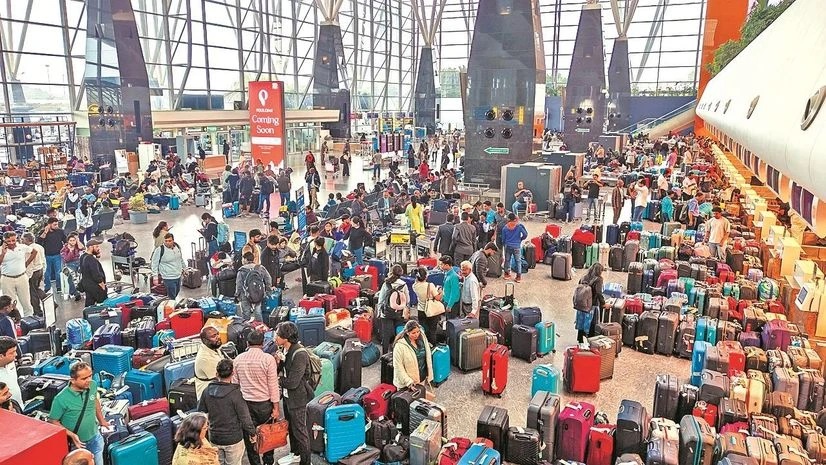
With IndiGo flight disruptions impacting thousands of passengers, the civil aviation ministry on Saturday directed the airline to complete the ticket refund process for cancelled flights by Sunday evening and ensure that baggage separated from the travellers is delivered within the next two days.
The airline had cancelled over 1,000 flights on Friday. IndiGo said its teams are focused on stabilising schedules, reducing delays, and supporting customers during this period. IndiGo, in a statement, also said it is addressing all customer refund issues on a “priority” basis.
The refund process for all cancelled or disrupted flights must be completed by 8 pm on Sunday, the civil aviation ministry said in a statement. “Airlines have also been instructed not to levy any rescheduling charges for passengers whose travel plans were affected by cancellations,” it said.
IndiGo has also been instructed to set up a dedicated passenger support and refund facilitation cell. “These cells have been tasked to proactively contact affected passengers and ensure that refunds and alternative travel arrangements are processed without the need for multiple follow-ups. The system of automatic refunds will remain active until operations stabilise completely,” the statement said.
Further, the ministry said the airline should ensure that baggage separated from passengers due to flight cancellations or delays should be traced and delivered to them within the next 48 hours.
“The number of cancellations on Saturday dropped below 850 flights, much lower compared to Friday. We are continuing to work towards reducing this number progressively over the next few days,” IndiGo said. The airline’s teams are focused on stabilising schedules, reducing delays, and supporting customers through this period, it said, adding, “We are also working closely with all airports and partners to ensure timely updates are provided to customers at terminals, on our website, and via direct notifications.”
In the two-page order on capping the airfares, the ministry said disruptions in flight operations of one of the scheduled airlines had resulted in flight cancellations, leading to capacity constraints and unreasonable surges in fares on a number of sectors.
The fare limits, excluding applicable charges, are not applicable for business class and UDAN flights, the civil aviation ministry said in an order. However, the order did not provide clarity on whether the caps are applicable for economy class tickets or both economy and premium economy class tickets.
Under the limits, for a flight flying up to 500 kilometres, the fares are capped at Rs 7,500, and for 500-1,000 kilometres, the ticket price cap is Rs 12,000. For flights operating 1,000-1,500 kilometres, the fares are limited to Rs 15,000, and for flights above 1,500 kilometres, the cap is Rs 18,000. This means that for a Delhi-Mumbai flight, which covers a distance of over 1,300 kilometres, the fare for at least the economy class is capped at Rs 18,000. The limits will remain in place until the situation stabilises, the ministry said in a statement.
It excludes User Development Fee (UDF), Passenger Service Fee (PSF), and taxes on air tickets.
The ministry, in the statement, said it will continue to closely monitor fare levels through real-time data and active coordination with airlines and online travel platforms, adding that any deviation from the prescribed norms will attract immediate corrective action in the larger public interest.
“These fare limits shall be applicable for all forms of bookings, regardless of whether the purchase is made directly through the airline’s official website or through various online travel agents’ platforms,” it said.
The ministry has also asked airlines to avoid steep or unusual upward fare revisions on sectors affected by the cancellations.
An analysis of fares on airlines’ websites on Friday showed that a one-way, one-stop economy-class SpiceJet Kolkata-Mumbai flight ticket for December 6 was priced up to Rs 90,000, and a similar ticket for Air India for Mumbai-Bhubaneswar went up to Rs 84,485.
Indian Association of Tour Operators (IATO) President Ravi Gosain said unpredictable spikes damage consumer confidence and create chaos for tour operators. “A temporary fare cap may provide immediate relief, but the durable solution is better contingency planning, rapid capacity deployment, and transparent fare monitoring,” he noted.
Federation of Associations in Indian Tourism & Hospitality (FAITH) Board Member Anil Kalsi said the fare cap is essential to protect flyer rights in India, and there is a need for a permanent policy in this regard.